
Governed Chromatography: Track Every Peak Across Four CDS Platforms — Compare Impurity Profiles Across Sites
Your lab runs Empower™ Chromatography Data System (CDS), OpenLab, LabSolutions, and Chromeleon — often simultaneously. Every cross-system comparison means manual export, reformatting, and re-validation. Audit trails fracture at system boundaries. Impurity profiles and dissolution results cannot be compared across sites. ZONTAL governs chromatography data from all four CDS platforms into a single, contextualized infrastructure — AI-ready for predictive method failure detection, automated impurity trending, dissolution profile comparison, and cross-program stability modeling.
Chromatography Data Complexity
Analytical chemists and QC managers live with 3–5 different CDS platforms daily. Each stores data in proprietary formats, with vendor-specific peak integration parameters and method-dependent retention time windows. Moving data between systems requires manual export, reformatting, and re-validation — multiplied across every instrument, method, and program.
Multi-Vendor Landscape
Waters Empower CDS, Agilent OpenLab, Shimadzu LabSolutions, and Thermo Fisher Chromeleon each use proprietary file formats and data models. A single analytical development lab may operate all four simultaneously.
Proprietary Binaries
CDS-specific binary files lock raw chromatographic data inside vendor ecosystems. Extraction requires per-vendor parsers that must track every software version and firmware update.
Peak Integration Variability
Integration parameters, baseline algorithms, and retention time windows vary by method, instrument, and CDS version — making cross-system comparison unreliable without harmonization.
Regulatory Traceability
Every chromatographic result submitted to regulators requires a complete audit trail from raw acquisition through processing parameters to reported values. Regulatory affairs teams assembling Investigational New Drug (IND) or New Drug Application (NDA) submissions face this traceability burden across systems and sites.
Digital Analytical Methods & Cross-Vendor Comparison
Analytical methods today live in PDF SOPs, CDS-specific configurations, and tribal knowledge. ZONTAL transforms them into structured, machine-readable method descriptions — extracting chromatographic data alongside the method parameters that produced it, so you can compare results across CDS platforms, overlay chromatograms from different sites, and track method performance across your entire fleet.
From PDF Methods to Executable Data
- Structured method descriptions: Gradient profiles, mobile phase composition, column specifications, flow rates, detector wavelengths, and integration parameters are extracted as named, typed, searchable fields — not locked in PDF SOPs or CDS-specific configurations. Methods become machine-readable and comparable.
- Cross-vendor chromatographic overlay: Overlay chromatograms from Empower CDS, OpenLab, LabSolutions, and Chromeleon in a single governed view. Compare peak profiles, retention times, and integration results side by side — regardless of which CDS produced them.
- Method equivalence analysis: When two sites run the same analytical method on different CDS platforms, ZONTAL compares system suitability parameters (resolution, tailing factor, plate count, %RSD) automatically — detecting method drift before it impacts batch release or tech transfer qualification.
- Allotrope alignment: ZONTAL's chromatographic data model aligns with the Allotrope liquid chromatography schema — the industry standard for vendor-neutral representation of peaks, chromatograms, method parameters, and injection sequences. Data extracted from any CDS maps to a common vocabulary that Allotrope Foundation members already recognize.
Contextualized Chromatographic Data
Raw chromatographic results gain meaning when connected to their full scientific context. ZONTAL links every injection, peak, and integration result to the method, sample, instrument, column, and experimental conditions that produced it — giving method validation scientists the complete parameter traceability they need.
Method Parameters
Mobile phase composition, gradient profiles, flow rates, column specifications, and detection wavelengths are captured and linked to every chromatographic run.
Sample Genealogy
Each injection traces back to its sample preparation, batch, study, and program — enabling cross-program queries that start from a single chromatographic result.
Instrument & Column History
System suitability results, column usage logs, and instrument qualification records are linked to every run — supporting fleet-wide performance tracking.
Context Graph
All chromatographic metadata feeds into ZONTAL's scientific context graph, connecting retention behavior, peak profiles, and method conditions across the portfolio.
Cross-Program Chromatographic Intelligence
With chromatography data governed and contextualized, ZONTAL enables analytical intelligence that spans instruments, methods, sites, and programs — serving stability scientists, tech transfer leads, and regulatory affairs teams.
Cross-Program Comparability
When your QC lab in Dublin runs the same forced degradation method as the development lab in Boston, retention times shift by 0.2 minutes between systems. Without harmonized integration parameters, impurity profiles look different — even when the chemistry is identical. ZONTAL compares impurity profiles, dissolution results, and assay data across sites and development phases with full lineage to source instruments and methods.
Method Performance Trending
A method development scientist notices resolution between peaks 3 and 4 has dropped from 2.8 to 1.9 over six months across three instruments. ZONTAL's System Suitability Test (SST) trending surfaces the drift before the method fails SST criteria — tracking retention time drift, resolution, and tailing factors across your fleet.
Stability Intelligence
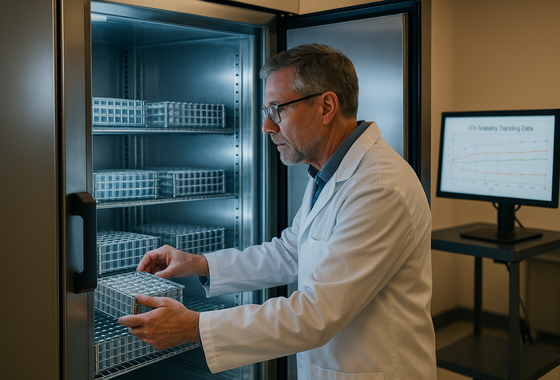
Stability scientists depend on chromatographic stability-indicating methods and dissolution testing to detect degradation and release-rate trends early. ZONTAL feeds impurity, assay, and dissolution data directly into predictive shelf-life models, with trend analysis spanning products and ICH storage conditions across your portfolio.
Tech Transfer Tracking
During a Phase III to commercial manufacturing transfer, the receiving site's Chromeleon system produces tailing factors that differ from the sending site's Empower CDS results. ZONTAL normalizes the comparison — tracking chromatographic equivalence across CDS platforms for tech transfer leads managing site-to-site method transfers.
Chiral Separation: Method Screening Through Purification
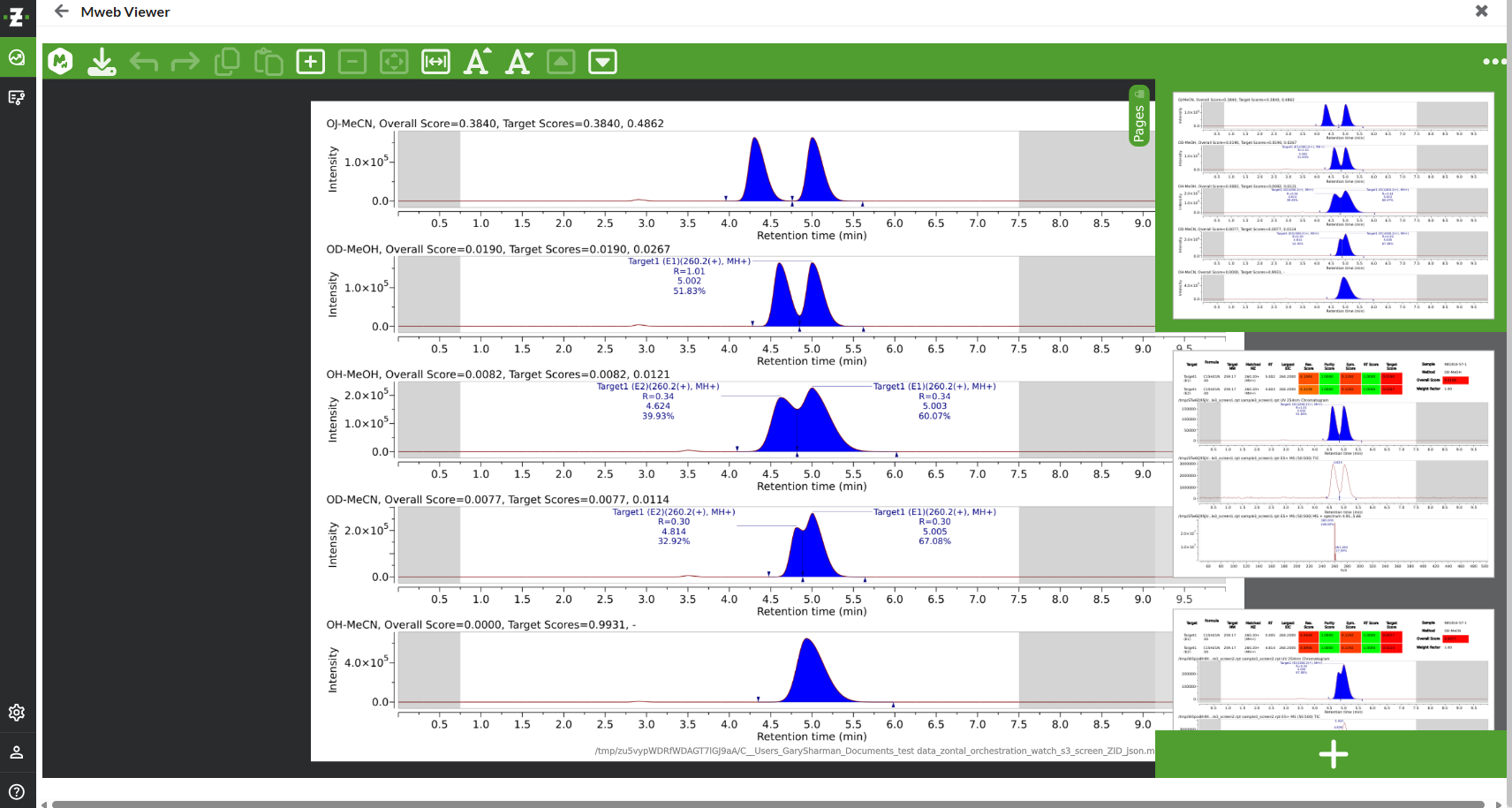
Chiral LC and UPLC™ workflows — method development, preparative separation, fraction collection, and enantiomeric purity confirmation — span multiple instruments, liquid handlers, and analytical checks. ZONTAL orchestrates the entire workflow as a single governed thread with full sample lineage from racemate to purified enantiomer.
Automated Method Screening
Analytical experts configure scouting conditions — column, mobile phase, gradient — and ZONTAL drafts instrument requests for chiral LC systems. Data flows back automatically as runs complete, and automated processing reports resolution, selectivity, k', and co-solvent percentage for each condition set. The best method is flagged for the expert's review.
Preparative Separation & Fraction Lineage
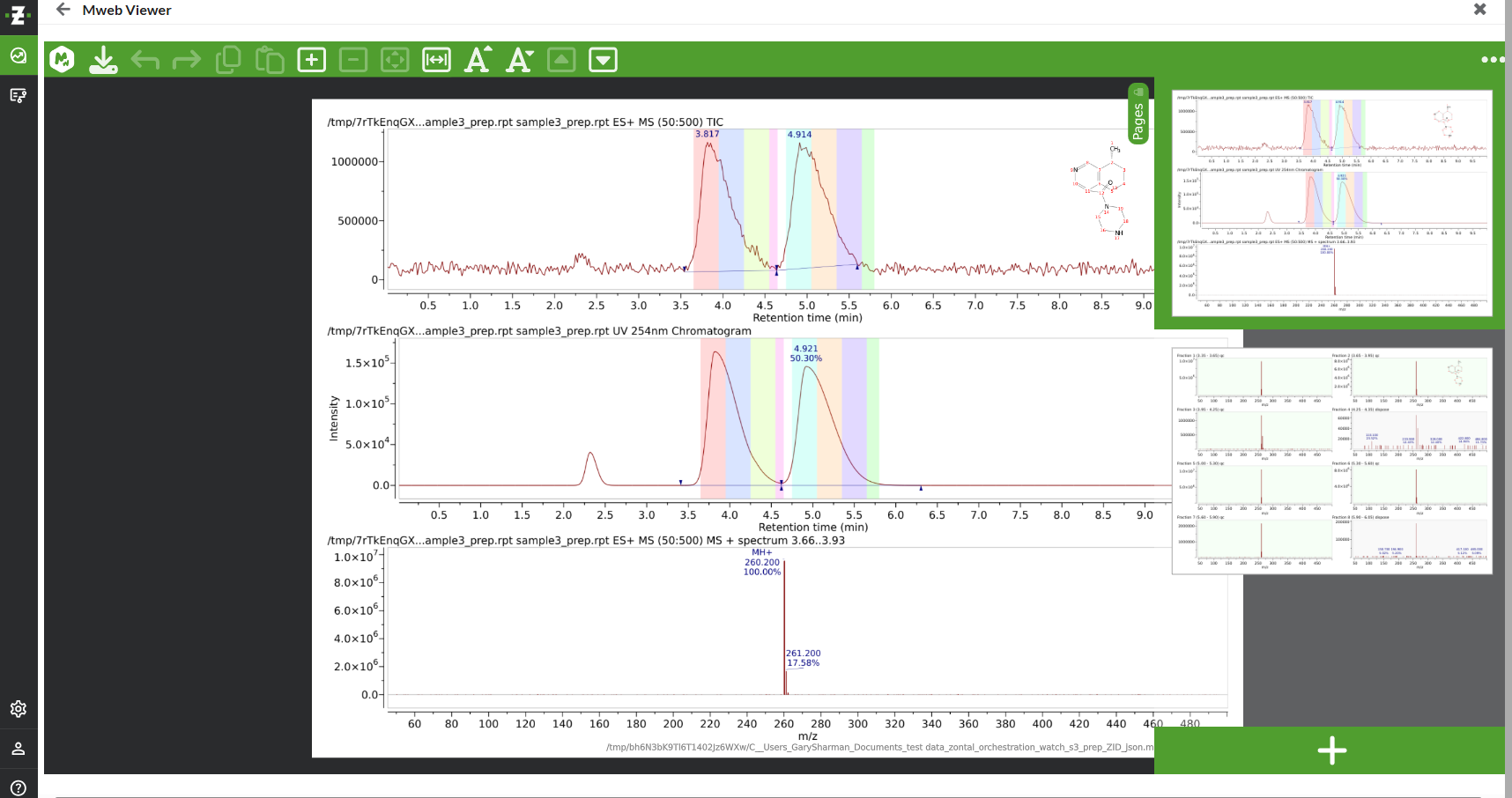
When method screening passes, ZONTAL triggers preparative separation within the same workflow context. Stacked injections, fraction collection, and downstream liquid handling are coordinated with local orchestrators (synTQ). Every fraction is registered as a sample entity with explicit parent-to-child lineage — collection time, vial position, chromatographic parameters, and originating racemate are preserved as governed metadata.
Quality Control & Documentation
Purified fractions progress to LC-MS QC confirmation. Pass/fail outcomes are derived directly from analytical results — enantiomeric excess, purity, and identity — enabling a review-by-exception approach. Results, chromatograms, and the full workflow record are documented to the ELN and LIMS automatically. Failed fractions trigger additional separation rounds or expert review within the same governed workflow.
End-to-End Traceability
Every step — from the chemist's ELN request through method screening, preparative runs, fraction pooling, and QC confirmation — is captured in ZONTAL with complete audit trail, workflow context, and sample lineage. Regulatory reviewers can trace any purified enantiomer back to the originating compound, the screening conditions evaluated, and the analytical evidence supporting its identity and purity.
Dissolution Testing: From USP Apparatus to Release Profile
Dissolution testing determines how a drug product releases its active ingredient over time — a regulatory-critical measurement for every solid oral dosage form. Each dissolution run generates 6–12 HPLC injections per time point across 6–12 vessels, producing hundreds of chromatographic results per batch. ZONTAL governs the complete dissolution workflow — from apparatus parameters through HPLC quantification to dissolution profile generation — as a single traceable thread.
Apparatus-to-Chromatograph Lineage
Dissolution samples move from USP Apparatus I (basket) or Apparatus II (paddle) through auto-samplers into HPLC systems for quantification. ZONTAL captures the full lineage: apparatus type, rotation speed, medium composition, temperature, sampling time points, vessel position, and the downstream chromatographic injection that quantifies each sample — linking every data point back to its physical origin.
Cross-Site Profile Comparison
When QC labs at three manufacturing sites run the same dissolution method, differences in apparatus calibration, medium preparation, and HPLC system suitability create variability that obscures genuine formulation differences. ZONTAL normalizes dissolution profiles across sites and calculates f2 similarity factors automatically — surfacing method equivalence issues before they become regulatory findings.
Real-Time Profile Generation
As each time-point sample completes its HPLC run, ZONTAL updates the dissolution profile curve in real time — plotting percent drug released against time for all vessels simultaneously. QC analysts see the profile building rather than waiting for manual compilation after the final time point, enabling earlier detection of vessel failures or out-of-specification trends.
Regulatory Filing & Batch Release
Dissolution data appears in every NDA, Abbreviated NDA (ANDA), and post-approval batch release record. ZONTAL assembles dissolution profiles with complete traceability: apparatus parameters, medium lot numbers, HPLC system suitability results, integration parameters, and the chromatographic evidence behind every reported value — ready for regulatory submission under ICH Q1A and Q6A requirements.
Supported Chromatography Platforms
ZONTAL maintains converters for the chromatography platforms used across pharma R&D and manufacturing.
| Vendor | Models / Platforms | CDS Software | Techniques |
|---|---|---|---|
| Agilent | 1260 Infinity II, 1290 Infinity II, Intuvo GC, 1260 Infinity II Bio-SEC | OpenLab CDS | HPLC, UHPLC, GC, IC, SFC, GPC/SEC |
| Shimadzu | Nexera Series, Prominence-i, GC-2030, Nexera GPC | LabSolutions | HPLC, UHPLC, GC, IC, GPC/SEC |
| Thermo Fisher | Vanquish, UltiMate 3000, TRACE 1310/1610 | Chromeleon | HPLC, UHPLC, GC, IC, GPC/SEC |
| Waters | ACQUITY™ UPLC™, Alliance™ HPLC, Arc HPLC, ACQUITY™ UPC² | Empower CDS | HPLC, UHPLC, SFC, GPC/SEC |
Empower, ACQUITY, UPLC, and Alliance are trademarks of Waters Corporation. All other trademarks are the property of their respective owners.
Explore Connected Capabilities
Stability Intelligence
Chromatographic stability data feeds predictive shelf-life models across your portfolio.

CMC Readiness
Governed chromatographic evidence packages for regulatory submissions.

QC Release Throughput
Fleet-level batch release monitoring

IND Acceleration
Months saved per filing
Governed Chromatography Data Starts Here
From CDS extraction to cross-program intelligence — connect your chromatography through ZONTAL's scientific evidence infrastructure.