
Industrialized Integration Infrastructure for AI-Centric Labs
Repeatable delivery systems that transform instrument integration from one-off projects into a validated, repeatable production capability — with measurable reuse, embedded validation, and AI-assisted acceleration.
The innovations described in the content herein are subject to patent rights present within a global patent portfolio developed and managed for the benefit of ZONTAL. All rights reserved.
The Operating Model Problem in Enterprise Labs
Large pharma organizations face a persistent mismatch between AI ambitions and lab reality. Instrument estates are heterogeneous, data is fragmented across proprietary formats, and integration is executed as artisanal, project-based work.
Slow Onboarding
Weeks to months for each new instrument type. Serial work, high handoff overhead, and inconsistent delivery timelines hold back fleet expansion.
High Validation Overhead
Manual evidence recreation and inconsistent validation across instruments. Each integration cycle restarts quality assurance from scratch.
Limited Reuse
Knowledge stays tribal, patterns are rediscovered, and integration work never compounds. Every new variant is treated as a greenfield effort.
From Projects to Industrialized Capability
Integration Factories replace one-off project work with a repeatable, auditable production line. Patterns are captured once and reused across sites, vendors, and instrument variants.
How It Used to Work
- Weeks to onboard new instrument types with serial work
- Accidental, inconsistent reuse with tribal knowledge
- Manual evidence recreation and inconsistent validation
- High bespoke effort per instrument with common rework
- Strong dependence on key individuals
- Data heterogeneity blocks scalable analytics
How Factories Change It
- Hours to days for first reusable asset with parallel workstreams
- Patterns captured once and reused across sites, vendors, variants
- Repeatable verification with evidence generated by design
- Declining marginal cost as templates and adapters accumulate
- Documented procedures, runbooks, and auditable lifecycle
- Standard models plus lineage make data machine-ready
What Are Integration Factories
Two specialized factories combine proven software engineering practices — templates, automated testing, version control, release gates — with lab-domain standards and knowledge bases. Each factory scales: once a pattern is captured, it becomes a reusable asset deployed repeatedly with consistent quality.
Data Converter Factory
Industrializes conversion of vendor-specific files into standardized, analysis-ready data in Allotrope Simple Model (ASM). Takes vendor exports, run logs, and results as inputs and produces ASM-conformant datasets with consistent structure, units, and semantics.
ASM · Standardized DataInstrument Adapter Factory
Industrializes instrument connectivity by exposing instrument capabilities through standard automation interfaces. Maps proprietary protocols to OPC UA and SiLA 2, enabling consistent deployment into orchestration and fleet-management environments.
OPC UA · SiLA 2What Factories Deliver
Integration Factories transform integration from a recurring cost and risk into reusable infrastructure that compounds in value across sites, vendors, and instrument variants.
Time-to-Value
Faster onboarding of new instruments, techniques, and sites. Accelerated tech transfer and method rollout across your organization.
Scalability
Integration workstreams can be parallelized because they share templates, quality gates, and governance — removing the serial bottleneck.
Compliance Readiness
Repeatable, auditable procedures reduce manual evidence recreation and improve traceability across every integration deployment.
AI Amplification
Standardized structure and interoperable interfaces enable scalable analytics, semantic search, and model development across your data estate.
Operational Resilience
Reduced dependence on tribal knowledge through runbooks, documented patterns, and lifecycle controls that persist beyond individual contributors.
Talent Multiplication
Scarce domain experts spend more time on high-value decisions and less on repeated integration mechanics. Expertise compounds rather than evaporates.
From New Format to Approved Converter
Submit a new instrument format, upload example files, and review the generated converter output against test data — the full lifecycle in two screens.
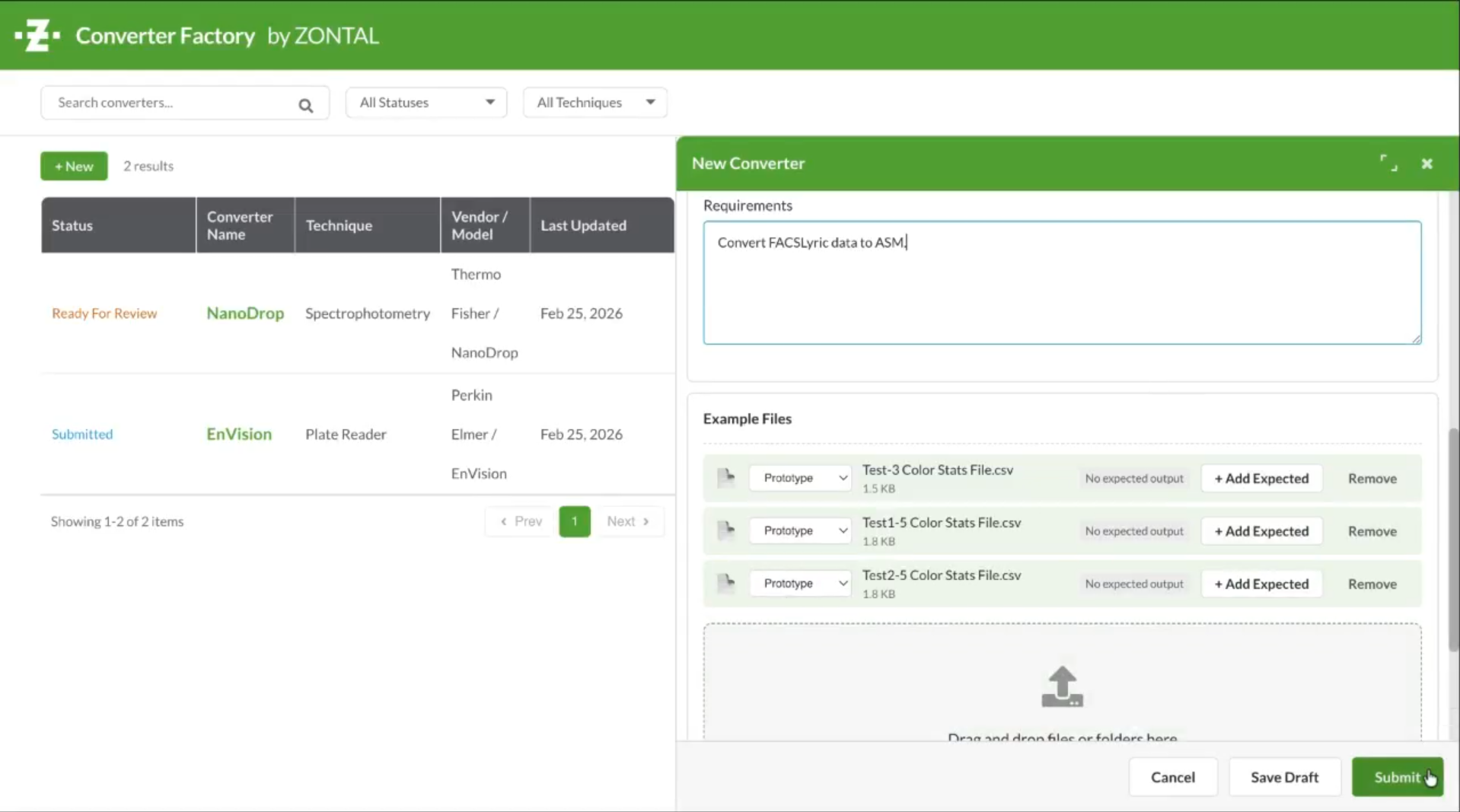
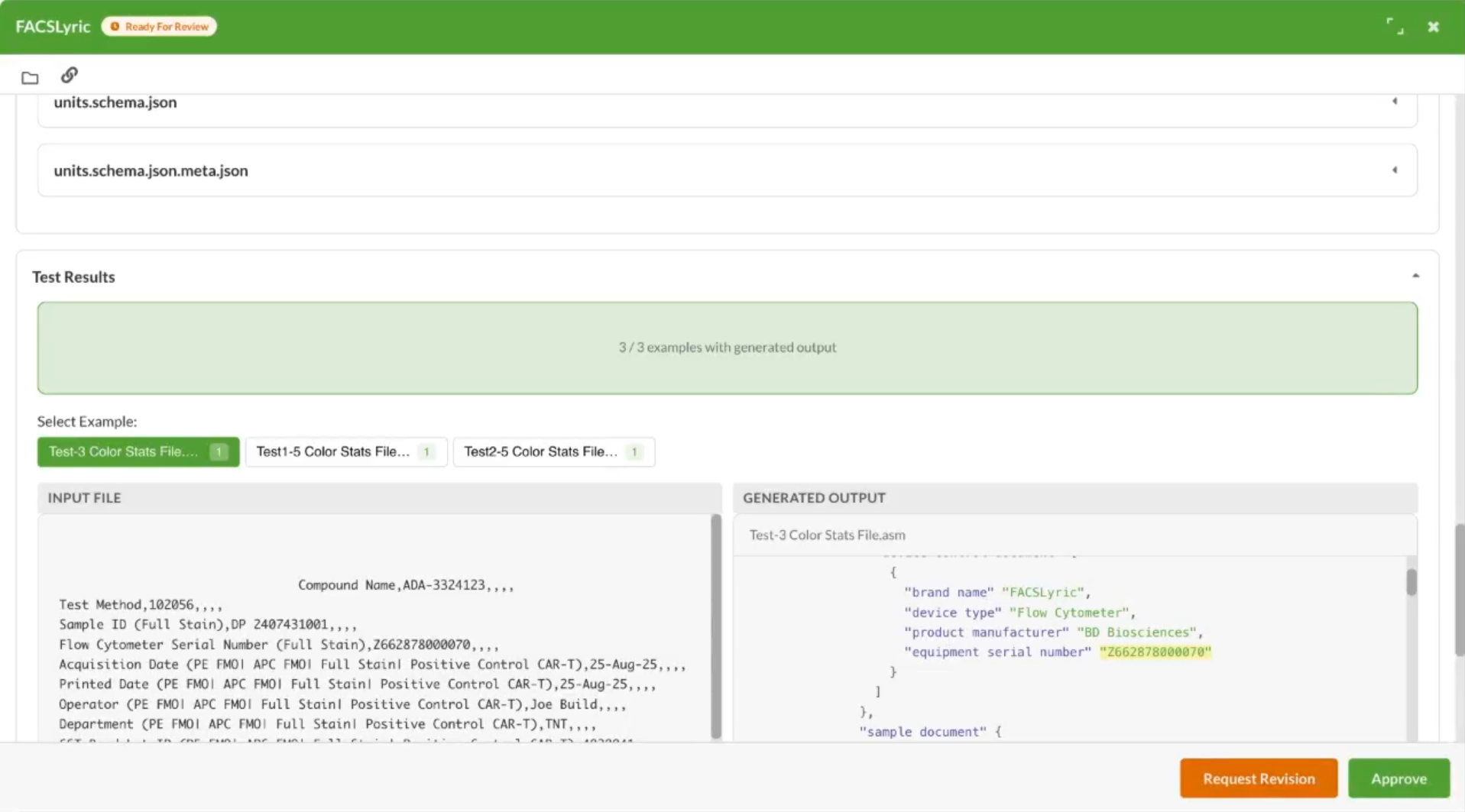
Converter Factory — from Vendor File to Self-Describing Data Asset
From new instrument format submission through automated conversion, test validation, and approval — the full converter lifecycle.
Measurable Impact
Factory-based integration delivers compounding returns. Customers compress onboarding timelines, reduce rework, and establish AI-ready digital assets with traceable lineage.
Six Phases, Repeatable by Design
Every factory engagement follows a structured lifecycle. Each phase produces defined artifacts, passes quality gates, and captures patterns for future reuse.
Intake
Confirm scope, inputs, stakeholders, and success criteria
Design
Align target systems, mappings, and acceptance tests
Build
Implement converter templates or adapter mappings with automated tests
Verify
Execute repeatable verification and generate required evidence
Deploy
Package and release to target environments with change control
Operate
Monitor, incorporate feedback, and extend patterns to new variants
Build and Verify Without the Instrument
Laboratory instruments run production around the clock. Multi-shift QC labs have no convenient maintenance windows. Taking an HPLC or mass spectrometer offline to validate a new adapter means pausing real analytical work. Simulation mode removes that constraint.
Protocol-Accurate Simulation
Every instrument adapter produced by the Adapter Factory includes a built-in simulation mode. The same adapter code that communicates with production hardware can replay the instrument's protocol behavior on an engineering workstation — OPC UA service calls, SiLA 2 command sequences, device status transitions, and error conditions.
The design → build → verify cycle runs entirely without a physical instrument connection. Hardware commissioning becomes a focused final step: confirm the adapter against the real device, generate the commissioning evidence, and hand off to operations.
Decouple from Lab Schedules
Integration engineers build and verify adapters while instruments run production. No downtime requests, no scheduling conflicts, no blocked sprints.
Pre-Procurement Readiness
When a lab orders a new instrument class, the adapter can be built and validated before the hardware arrives. Data flows from day one of installation.
Multi-Site Rollout Without Travel
Adapters validated in simulation at one site deploy to remote sites with minimal on-site commissioning. The heavy engineering is done before anyone boards a plane.
Risk-Free Automation Testing
Closed-loop automation workflows can be validated end-to-end in simulation before touching production instruments — critical in GxP environments where unvalidated automation on production equipment is a compliance risk.
Extend Factories to Outsourced Research
Pharmaceutical companies increasingly outsource development work to Contract Research Organizations (CROs) and Contract Development and Manufacturing Organizations (CDMOs). Integration infrastructure must extend beyond internal lab walls. Integration Factories produce the same governed, version-controlled converters for external partner instrument fleets as for internal instruments.
Same Factory, External Fleet
CRO and CDMO partners run the same instrument vendors — Waters, Agilent, Thermo Fisher, Shimadzu. Converters already support their instruments. Partners export raw instrument outputs, proprietary vendor formats, and PDF; the converter transforms them into vendor-neutral formats, validates, and governs the data on arrival. No platform deployment at partner sites required.
Audit Trail Across Boundaries
Outsourced stability studies, method validation runs, and analytical testing must trace back to the source instrument for regulatory submissions. Integration Factories preserve full provenance from the CRO instrument through format conversion, validation, and ingestion — the same 21 CFR Part 11 compliant audit trail as internal data.
Accelerated Partner Onboarding
Every factory-built converter compounds reuse. When a new CRO runs the same Agilent HPLC models already in your fleet, the converter is already built, tested, and validated. Onboarding a new external partner's instruments takes days, not months — the same compression ratio that applies to internal instrument rollouts.
Every Build Compounds on the Last
As factory assets accumulate, each successive integration becomes faster, cheaper, and more reliable. Marginal effort declines while coverage expands.
First Instrument
Initial onboarding compressed from weeks to days. First reusable pattern created.
Variant Extension
Templates extend to related instruments. Marginal effort drops significantly.
Site Rollout
Controlled release across multiple sites. Enterprise reuse becomes measurable.
Fleet Scale
Standard interfaces enable intelligent orchestration and fleet-wide optimization.
“Converter development takes a lot of time… with the work that we’ve done with ZONTAL… we can speed that up.”
From “From Instruments to Intelligence: Scaling ASM Across the Lab Enterprise” (2026 Spring Allotrope Connect Workshop, Allotrope Foundation, May 18, 2026).
Ready to Industrialize Your Lab Integrations?
See how Integration Factories compress onboarding timelines, reduce validation overhead, and create AI-ready evidence infrastructure for your organization.