
Every Instrument Connected. Every File Converted. Every Field Enriched.
Governed data ingestion connects instruments from 150+ vendors and 400+ models, converts proprietary formats into standardized scientific data, and enriches metadata beyond vendor limits — automatically, at scale, from Day 1.
The innovations described in the content herein are subject to patent rights present within a global patent portfolio developed and managed for the benefit of ZONTAL. All rights reserved.
Onboarding New Instruments Takes Too Long
Every new instrument model requires weeks of custom integration work. Each vendor exports data in a proprietary format with unique file structures and metadata schemas, forcing teams to build bespoke parsers one at a time. Critical metadata is lost in translation, and every firmware update risks breaking existing connections. The result: a growing backlog of disconnected instruments and ungoverned data.
From Raw Instrument Output to Governed Scientific Data
Four products work together to transform instrument onboarding from a months-long IT project into a repeatable, governed workflow.
Integration Factory Produces Converters
The Integration Factory produces validated converters for new instrument models at an accelerating pace. Each converter handles extraction, parsing, and format normalization — built once, reused across every site that runs that instrument. Every adapter includes simulation mode: the full build and verify cycle runs without a physical instrument connection, so converter development never competes with production for hardware access.
Product: Integration Factory · Integrations CatalogData Hub Converts and Enriches
Data Hub receives raw instrument output, applies the appropriate converter, and enriches the result with metadata that goes beyond what the vendor provides — run parameters, calibration context, method references, and instrument identifiers.
Product: Data Hub · Technique ApplicationsFleet Dashboard Monitors Health
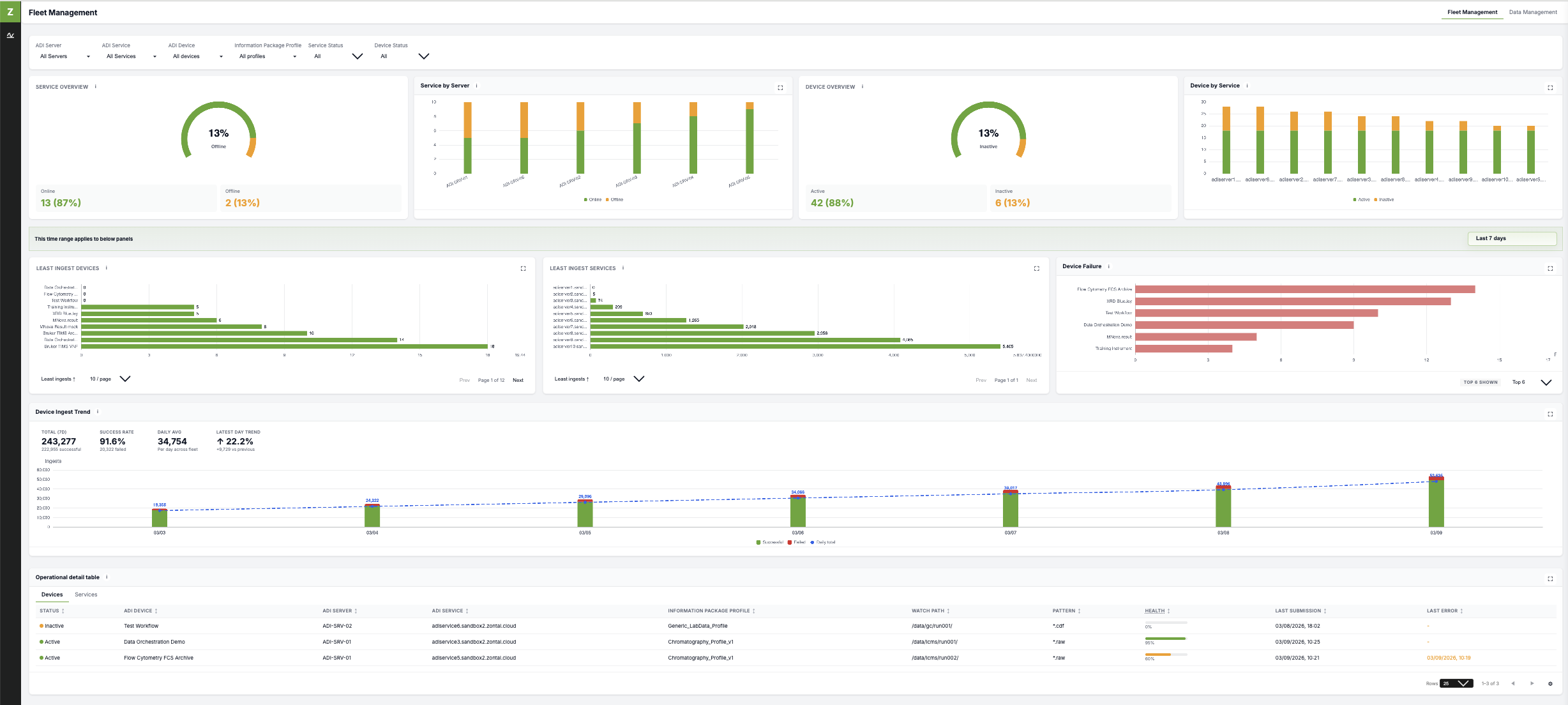
Fleet Dashboard provides real-time operational visibility across all connected devices — ingestion success rates, failure classification, device status, and data volume trending. Your operations team monitors fleet health, not ticket queues.
Product: Fleet DashboardIP Lifecycle Governance
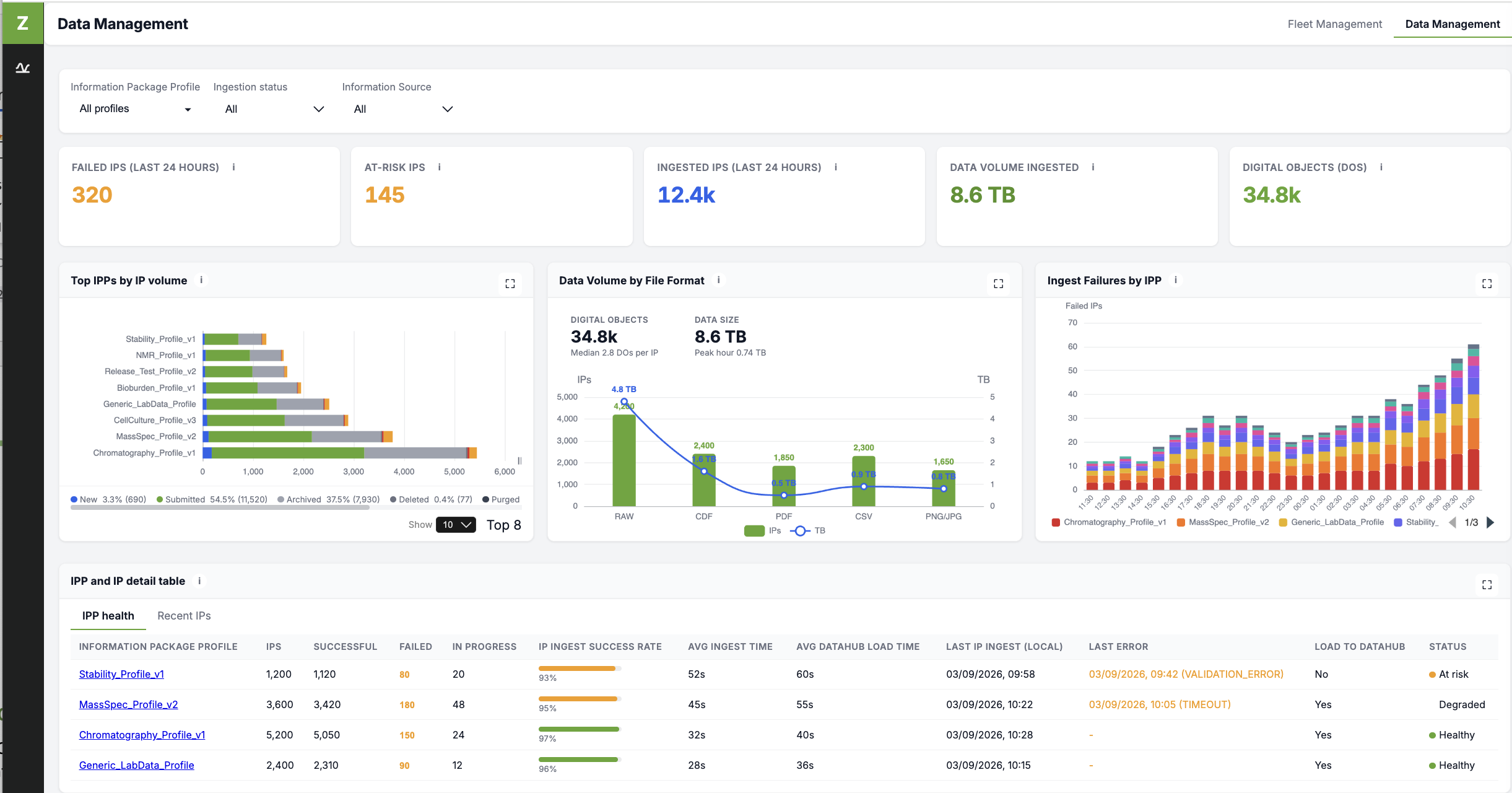
Every Information Package follows a governed lifecycle from ingest to archive. Data is validated against its profile, classified by type, and tracked through each state — New, Submitted, Archived — with full provenance at every step.
Product: Scientific Context & LineageThousands of Instruments, One Dashboard
Operational fleet monitoring and data management dashboards — device health, ingestion success rates, and failure classification across your entire instrument landscape.
Operational Impact from Day 1
Governed data ingestion transforms how labs connect instruments, monitor fleet health, and maintain data lineage across the entire instrument landscape.
New instrument models go from weeks of custom integration to days of standardized onboarding through the Integration Factory.
Device status, ingestion success rates, and failure classification across every connected instrument — visible in a single operational pane.
Every Information Package tracked from ingest to archive with complete provenance — instrument, method, sample, batch, and program context.
How Governed Ingestion Creates a Reusable Foundation
Governed data ingestion spans the first two principles. Integration industrializes instrument connectivity; the context engine contextualizes every data point into the scientific knowledge graph.
Every governed data point you ingest today builds the AI-ready foundation
for tomorrow. AI models require validated, contextualized scientific data — not raw instrument
files.
Evaluate readiness with the five-question
framework →

Integration Industrialization
Data Hub connects 150+ vendors and 400+ instrument models through governed Integration Factories. Every data point is validated and traced from source instrument to scientific context with full provenance. Integration Factories produce governed converters at scale. Fleet Dashboard monitors operational health across every connected device in real time.
- 150+ vendor instruments supported
- 400+ instrument models connected
- 8 core techniques · 80+ variants
- Fleet Dashboard monitors operational health across every connected device

Scientific Context & Lineage
Digital Lab and Platform Modules build the scientific context graph — ontology mapping, cross-system identity reconciliation, and full lineage from instrument through result to insight. Every ingested data point is contextualized within the scientific context graph. Lineage construction starts at ingestion — Contextualize depends on governed Integrate data quality.
- Ontology mapping across all data domains
- Cross-system identity reconciliation
- Full lineage graph: instrument → method → sample → result
- Provenance tracking from raw instrument data to scientific context
Validated by Industry Leaders
Published content from pharmaceutical and agrochemical companies solving real scientific data challenges.

How This Outcome Applies Across Scientific Domains
High-Volume Assay Data at Scale
Discovery biology workflows generate some of the largest datasets in pharma R&D — flow cytometry population files, high-content screening (HCS) image sets at 5 TB per experiment, plate reader kinetic curves across thousands of wells. Governed ingestion pipelines handle these volumes with full lineage from instrument to analysis, preserving scientific context that manual file transfers lose.
- Flow cytometry, plate reader, and mass spectrometry data ingested at scale
- High-content screening datasets (5 TB/file) with complete audit trails
- Dose-response and IC50 calculations linked to raw instrument data
- Compound-target assay relationships preserved through the context model
Preserving Scientific Context During Organizational Transitions
When two organizations merge, their instrument fleets, Laboratory Information Management System (LIMS) instances, and Electronic Lab Notebook (ELN) systems must converge into a single governed evidence infrastructure. Governed data ingestion provides the framework: cross-system reconciliation, entity resolution, and audit trail preservation — without losing the scientific lineage that makes the data valuable.
- Cross-system data harmonization preserving scientific lineage
- Entity resolution across duplicate instrument and sample records
- Audit trail continuity through organizational boundary changes
- Master data management for merged instrument fleets
Governed Data Exchange Across Organizational Boundaries
Pharmaceutical companies routinely outsource substantial portions of development work to Contract Research Organizations (CROs) and Contract Development and Manufacturing Organizations (CDMOs). When outsourced data arrives without governance, lineage, or standard formats, teams spend weeks reconciling before analysis can begin.
Auditable Cross-Organization Data Exchange
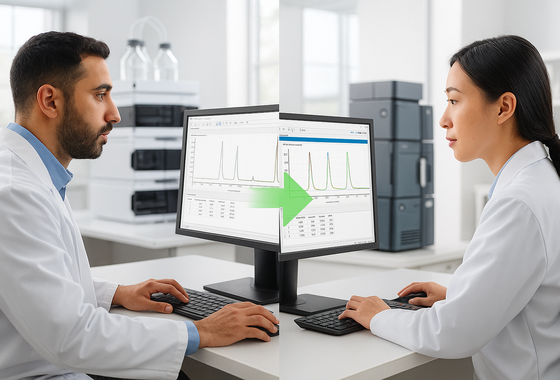
Governed ingestion pipelines apply the same validation, format standardization, and audit trail requirements to data from external partners as from internal instruments. CRO-generated chromatography runs, stability time points, and method validation results enter the platform with full provenance — no reconciliation required.
- Same validation rules for internal and external data sources
- Full audit trail from CRO instrument to your scientific context graph
- Allotrope Simple Model (ASM) and vendor-neutral formats eliminate CRO-specific data wrangling
No Platform Dependency for Partners
External partners do not need to adopt ZONTAL. Integration Factories produce governed data converters that accept raw instrument outputs, proprietary vendor formats, and PDF from CRO and CDMO instrument fleets — and convert them into vendor-neutral formats on arrival. Your partners export data however they already do; the factory handles the rest.
- CROs and CDMOs export raw outputs, proprietary formats, and PDF
- Factory-built converters transform into vendor-neutral, governed formats
- Zero software deployment required at partner sites
Cross-Site Regulatory Traceability
When outsourced studies contribute to regulatory submissions — Investigational New Drug (IND) applications, Chemistry, Manufacturing, and Controls (CMC) dossiers, or method transfers — every data point must trace back to its source instrument and conditions. Governed ingestion preserves that lineage across organizational boundaries, not just across internal sites.
- Lineage preserved from CRO/CDMO instruments through to regulatory submissions
- 21 CFR Part 11 compliant audit trails across organizational boundaries
- Tech transfer packages include full provenance from external partner data



Trusted by 6 of the 10 largest pharmaceutical companies in the world








And leading biotechs and agrochemical companies
“There has been a process of democratization of data. It is really easy, possible to access and to find information. And that’s a huge benefit.”
Build the Foundation for Governed Data Ingestion
Connect your instruments, convert proprietary formats, and monitor fleet health — from Day 1. Talk to our team about what governed ingestion looks like for your lab.