ICAD Platform — Analyze

Scientific Intelligence — Where Context Becomes Capability

Not a single application — a generative capability. The intelligence engine produces personalized, use-case-specific experiences from the governed context beneath it. A QC lead gets accelerated investigation with full context traversal. A process engineer gets tech transfer readiness across sites. A stability scientist gets trending and cross-program signals.

Analytics Foundation

Governed Data, Ready for Your Tools

Analyze provides SQL and API access to all governed data, with native integration into the analytics tools your teams already use.

Foundation

Analytics

SQL and API access to all governed data — the analytics-first interface for data scientists and analysts. Connect your existing Tableau, Spotfire, Power BI, Databricks, Snowflake, or Jupyter environments directly to the governed context graph. No CSV exports. No manual assembly. Live, governed, traceable data access at portfolio scale.

  • SQL and API access to the full governed data infrastructure
  • Native integration with Tableau, Spotfire, Power BI, Databricks, Snowflake, Jupyter
  • Analytics-first interface designed for data scientists
  • Portfolio-scale queries across programs, sites, and instruments

With governed data access in place, the following capabilities become possible.

Foundation

Data Processing

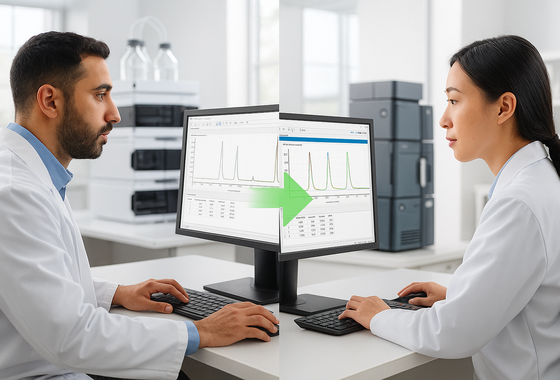
Scientific data processing and visualization for spectrometry and spectroscopy. Once Integrate ingests raw instrument data and Contextualize governs its context, SciYNova applies technique-specific algorithms to extract chemical knowledge: peak identification, spectral deconvolution, quantification, and structure elucidation.

  • Compound identification, quantification, and purification workflows
  • Structure characterization and reaction monitoring
  • Mixture analysis and spectral deconvolution
  • Ligand screening and binding analysis
  • High-throughput automated data workflow processing

SciYNova is available as a desktop application (with structure elucidation, spectral database, and molecular formula determination) and a browser-based edition (NMR, MS, and optical spectroscopy viewer embedded in ZONTAL or third-party applications like ELNs). SciYGears automates analytical reprocessing, analysis, and reporting pipelines — enabling closed-loop workflows where data from instruments is automatically processed, evaluated, and documented without manual intervention.

Foundation

Process Analytics

Real-time process control and Process Analytical Technology (PAT) knowledge management. While ZONTAL governs analytical data at rest, synTQ orchestrates process data in motion: multivariate process control, PAT instrument coordination, and real-time quality prediction across batch and continuous manufacturing workflows.

  • Real-time univariate and multivariate statistical process control (MSPC)
  • Critical Process Parameter (CPP) and Critical Quality Attribute (CQA) monitoring
  • Vendor-agnostic PAT instrument orchestration (OPC, Modbus, RS232, TCP/IP)
  • 21 CFR Part 11 compliant with ALCOA+ data integrity principles
  • Scale-up support from lab through pilot to GMP manufacturing
The Bottleneck

Analytics on Disconnected Exports

Today's analytical teams operate on CSV exports, Excel aggregations, and isolated LIMS reports. Every cross-program question requires weeks of manual data assembly — and the answers arrive too late to change the decision.

Export-Based Analytics

Stability trending, comparability analysis, and cross-program signals all start the same way: export data from LIMS, clean it in Excel, copy it into a separate analytics tool. The analysis is disconnected from the governed source — and stale before it's finished.


No Cross-Program Visibility

A degradation signal detected in one program may be invisible to teams working on structurally similar molecules in other programs. Without connected context across the portfolio, each program operates as an island — rediscovering risks that the organization already encountered.

Intelligence Arrives Too Late

By the time a cross-program trend report is assembled, reviewed, and delivered, the filing window has narrowed or the manufacturing decision has already been made. Insight that arrives after the decision point is documentation, not intelligence.

Analytical Outcomes

What Your Governed Data Unlocks

The analytics foundation above is deployed. These capabilities are what governed, connected data makes uniquely possible — Analyze operates on the governed context graph — not on disconnected exports — producing intelligence that compounds with every program added to the platform.

01

Accelerated Investigations

When an out-of-specification result, process deviation, or quality event occurs, the investigation starts immediately — not after weeks of data gathering. The intelligence engine traverses the context graph to identify related batches, materials, methods, and prior events, producing a structured investigation package that includes the full lineage of every entity involved.

OOS Root Cause Deviation Correlation Impact Assessment
02

Tech Transfer

Technology transfer between sites today requires 12–18 months of PDF-based batch record reconciliation. The intelligence engine packages the complete analytical context — methods, results, process parameters, equipment qualifications — into a structured transfer package with full lineage. Receiving sites get comparable data from day one, not after months of manual reconstruction.

Transfer Packages Method Equivalence Site Comparability
03

Stability Trending

ICH Q1A and Q5C stability programs generate continuous data across batches, temperatures, and timepoints. At portfolio scale, hundreds of active stability studies produce thousands of data points per quarter. The intelligence engine provides monomer trending, HMW aggregate alerts, proactive CQA monitoring, and cross-program degradation signal detection — all on governed, traceable data.

ICH Trending Degradation Signals CQA Monitoring Cross-Program Signals
04

CMC Readiness Analytics

Comparability analysis, method transfer tracking, and filing readiness gap detection across programs. CMC Readiness is a Decide outcome that draws on Analyze intelligence for cross-program pattern detection, then adding AI-enabled filing assembly. Surface the gaps before the FDA does — with full traceability from every data point back to its source instrument, method, and operator.

Comparability Method Transfer Filing Readiness Gap Detection
Generated Experiences

Each Use Case Gets Its Own Purpose-Built Experience

The intelligence engine does not deliver a monolithic dashboard. It produces personalized, use-case-specific experiences, each tuned to the role — personalized to the customer's data, compounding over time, and becoming indispensable.

QC lead reviewing batch release data and control charts on a monitor in a pharmaceutical QC laboratory
Quality Control

Investigation Acceleration & QC Oversight

Purpose-built for QC leads managing release testing across sites and products.

  • OOS root cause analysis with context traversal
  • Control chart trending with statistical limits
  • Batch release readiness assessment
  • Cross-site method equivalence monitoring
Development scientist reviewing technology transfer document on a tablet in a process development lab
Development Science

Tech Transfer & Process Understanding

Purpose-built for development scientists executing site-to-site technology transfers.

  • Structured transfer packages with full lineage
  • Receiving site comparability from day one
  • Equipment qualification mapping across sites
  • Process parameter range analysis
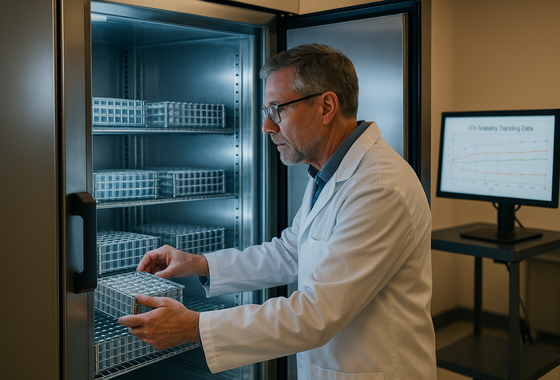
Stability scientist checking sample trays and chamber controls in a pharma stability testing area
Stability Scientist

Trending, Monitoring & Cross-Program Signals

Purpose-built for the stability lead managing hundreds of active studies across the portfolio.

  • ICH Q1A/Q5C trending with visual alerts
  • Monomer and HMW aggregate tracking across batches
  • Proactive CQA monitoring with risk levels
  • Cross-program degradation signal detection
CMC regulatory lead reviewing submission documents at desk with ICH guidelines
CMC Lead

Comparability, Method Transfer & Filing Readiness

Purpose-built for the CMC lead responsible for regulatory-grade data packages across programs.

  • Batch-over-batch comparability analytics
  • Method transfer tracking across sites
  • Filing readiness scoring per program
  • Assay robustness and validation status
Built for Scientists

Intelligence Designed for Scientists

Scientific Intelligence surfaces analytical insight across programs, sites, and time — turning governed data into decision-ready views. Explore the interactive experience below to see how each capability works.

Regulatory Evidence Preview

Browse the governed context graph to surface evidence completeness, identify gaps in CTD module coverage, and assess traceability chains — the intelligence foundation that feeds into Decide IND compilation.

Stability Trending Tab

Full ICH Q1A accelerated stability study: 3 temperatures × 7 timepoints × 3 replicates. Monomer trending, HMW aggregate alerts, charge variant monitoring by IEX. Degradation signal detection across programs from governed stability data.

Batch Comparison

Side-by-side analytical comparison across batches, sites, and time periods. SEC monomer purity, size variants, charge variants, and process parameters — all rendered from the governed context graph with full lineage to source instruments and methods.

Proactive CQA Monitoring

Critical quality attributes tracked across the portfolio: SEC monomer at 25°C, HMW aggregates, titer, PS-20 degradation — with trend direction, risk level, and alert thresholds. PS-20 degradation flagged as a risk signal across 3 IgG1 programs.

How Analyze Feeds Decide

Analyze intelligence — cross-program analytics, anomaly detection, and predictive signals — becomes the foundation for AI-enabled decisions. Without validated intelligence, Decide AI workflows operate on unverified assumptions.

This is the critical transition: from intelligence that informs scientists to supervised autonomy that acts alongside them. Every pattern identified, every signal validated in Analyze trains the AI workflows above to produce decisions that regulators accept and scientists trust.

Explore Decide: AI-Enabled Decisions →

Your ZONTAL Journey

Analyze establishes the INTELLIGENT stage. Your governed data produces cross-program analysis, stability prediction, and submission-ready evidence — intelligence that compounds with every program added to the platform.

1

Connected

Instruments integrated, data flowing, metadata enriched

2

Contextual

Scientific context graph, governed lineage, reconciled identifiers

3

Intelligent

Accelerated investigations and tech transfer

4

Autonomous

Portfolio intelligence, AI decisions, supervised automation

Each Principle Compounds on the One Before

Scientific intelligence requires governed context (Contextualize) and industrialized integration (Principle 1). Without the foundation, intelligence produces noise, not insight. With it, every program added makes every capability stronger.

“The first thing a structured digital method does is create a complete, consistent documentation of the analytical experiment. From there you can do many things.”

Vinny Antonucci, Head of Allotrope Foundation, Merck

Ready to See Intelligence on Your Data?

See how the intelligence engine transforms governed context into stability prediction, accelerated investigations, and submission-ready evidence — personalized to your portfolio.