Platform — Workflow Orchestration

Every Experiment Is a Workflow. Most Labs Run Them Manually.

Your analytical lab runs hundreds of measurements a week. Each one involves sample receipt, instrument scheduling, data acquisition, processing, review, and documentation — coordinated through emails, shared drives, and institutional memory. ZONTAL Operations transforms these fragmented steps into governed, dynamic workflows that adapt based on experimental outcomes, sample attributes, and expert decisions.

The Bottleneck

Workflows Held Together by Email, Memory, and Hope

Synthetic chemists requesting structure verification, analytical core teams running high-resolution experiments, lab automation leads configuring method sequences — every role depends on handoffs that break when the person who remembers the protocol is on vacation.

Manual Coordination

Sample lists drafted in Excel, emailed to instrument operators, results copied back into ELNs. A synthetic chemist requesting NMR + LC-MS structure verification submits the request by email, waits hours for scheduling confirmation, and manually checks each system for results. Every handoff is a potential error and delay point.
No Branching Logic

When a structure verification fails, what happens next? In most labs, the answer depends on who is available, what they remember, and whether the email reaches the right analytical expert in time. Escalation to the core team for high-resolution NMR and accurate MS/MS is ad hoc — governed by personal relationships, not workflow rules.

Lost Context

By the time results reach the ELN, the workflow context — why this analysis was requested, what conditions were specified, what previous steps preceded it — is lost. Documentation captures the answer but not the scientific reasoning. A lab automation lead configuring the next campaign cannot trace why the previous protocol was designed the way it was.

No Reusability

Every workflow is composed ad hoc. The optimized NMR + LC-MS structure verification protocol that an expert analytical chemist developed — with specific pulse sequences, column conditions, and pass/fail thresholds — cannot be templated, governed, or reused by open-access operators running routine measurements.

Analytical Outcomes

What Governed Workflow Orchestration Makes Possible

ZONTAL Operations composes, executes, and governs end-to-end analytical workflows spanning ELNs, LIMS, instruments, and processing software — replacing manual coordination with dynamic, branching workflows that adapt to experimental outcomes.

01

Dynamic Workflow Composition

Workflows are not static flowcharts — they adapt based on experimental outcomes, sample attributes, and expert decisions. A structure verification that passes routes directly to documentation; a failure triggers escalation to the analytical core team, with high-resolution NMR and accurate MS/MS automatically queued.

Conditional Branching Expert Escalation Adaptive Routing
02

ELN-Integrated Workflow Requests

Scientists request analyses from within their ELN — Revvity Signals, Benchling, or IDBS. ZONTAL drafts sample lists, assigns instruments based on availability and suitability, and creates logistics tasks — all from a single request. A synthetic chemist submitting a compound for structure verification never leaves their notebook.

Revvity Signals Benchling IDBS E-WorkBook
03

Automated Data Processing Pipelines

Upon data acquisition, ZONTAL triggers automated processing, analysis, and reporting via SciYGears. Structure verification, pass/fail evaluation, and spectral comparison happen without manual intervention — reducing turnaround from days to minutes for routine characterization workflows.

SciYGears Automation Pass/Fail Evaluation Spectral Comparison
04

Pass/Fail Branching with Expert Escalation

Configurable branching logic throughout the workflow. Automated pass/fail decisions based on analytical outcomes. Failure events trigger alerts, assignment to expert core teams, and additional high-resolution experiments — automatically. An analytical core team lead manages escalations from a governed queue, not an email inbox.

Decision Logic Alert Routing Queue Management
05

Sample Lineage & Provenance

Every workflow step — from ELN request through acquisition, processing, and documentation — is captured in a governed lineage graph. Parent–child–fraction relationships are preserved across synthesis, separation, and characterization steps. A sample's journey from compound registration through chiral purification to final structure confirmation is fully traceable.

Lineage Graph Fraction Tracking Full Provenance
06

Cross-System Integration

Bidirectional integration with ELN, LIMS, and CDS. Instrument scheduling, Lab2Lab logistics, and automation controller coordination — Biosero Green Button Go, synTQ, and Chemspeed. Integration with workflow management solutions like Camunda and Temporal for enterprise-scale orchestration across sites.

Biosero synTQ Camunda Lab2Lab
Product Experience

ZONTAL Operations in Action

From instrument request to documented result — see how workflow orchestration connects ELN integration, automated processing, and AI-assisted analysis.

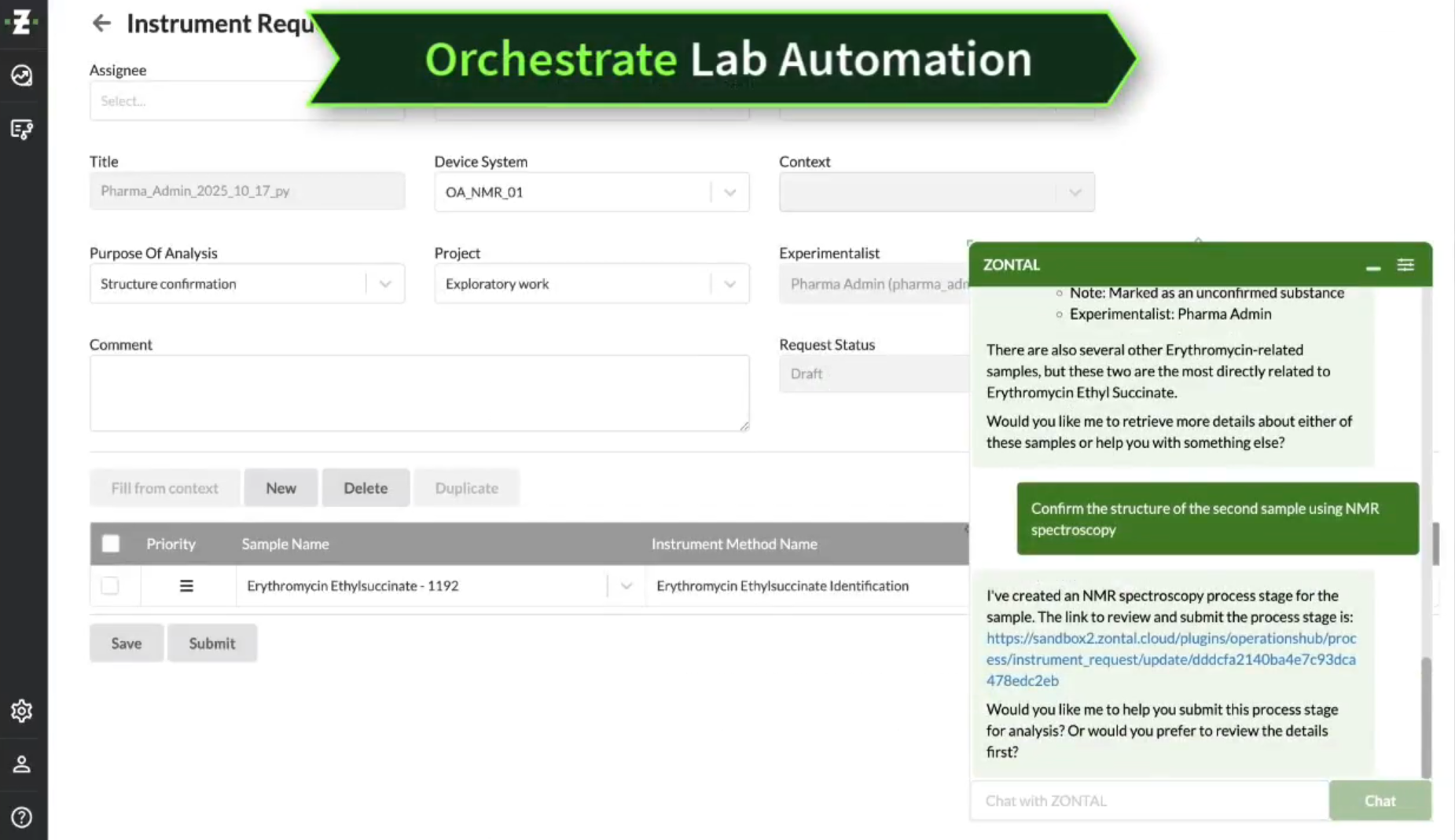
ZONTAL Operations instrument request form showing Erythromycin Ethylsuccinate NMR analysis with AI assistant creating process stages and offering to submit for analysis
Instrument Request — A synthetic chemist requests NMR structure confirmation. The ZONTAL AI assistant identifies related samples, creates the process stage, and offers to submit for analysis.
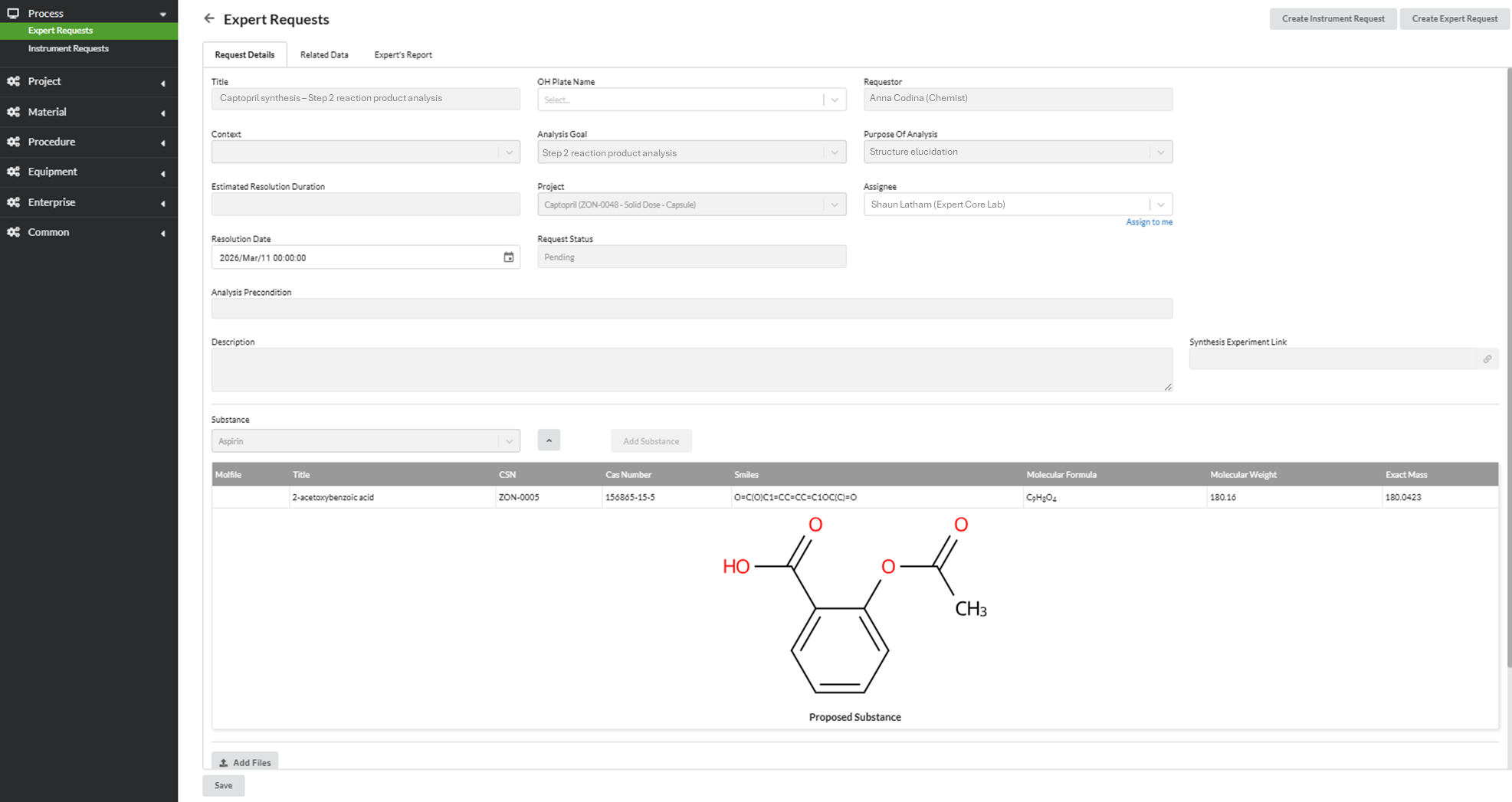
ZONTAL Operations expert request form for Captopril structure elucidation, showing requestor Anna Codina (Chemist), assignee Shaun Latham (Expert Core Lab), molecular structure, and substance metadata
Expert Request — When automated verification fails, ZONTAL escalates to the analytical core team. The expert request captures the compound structure, requestor context, and analysis goal.
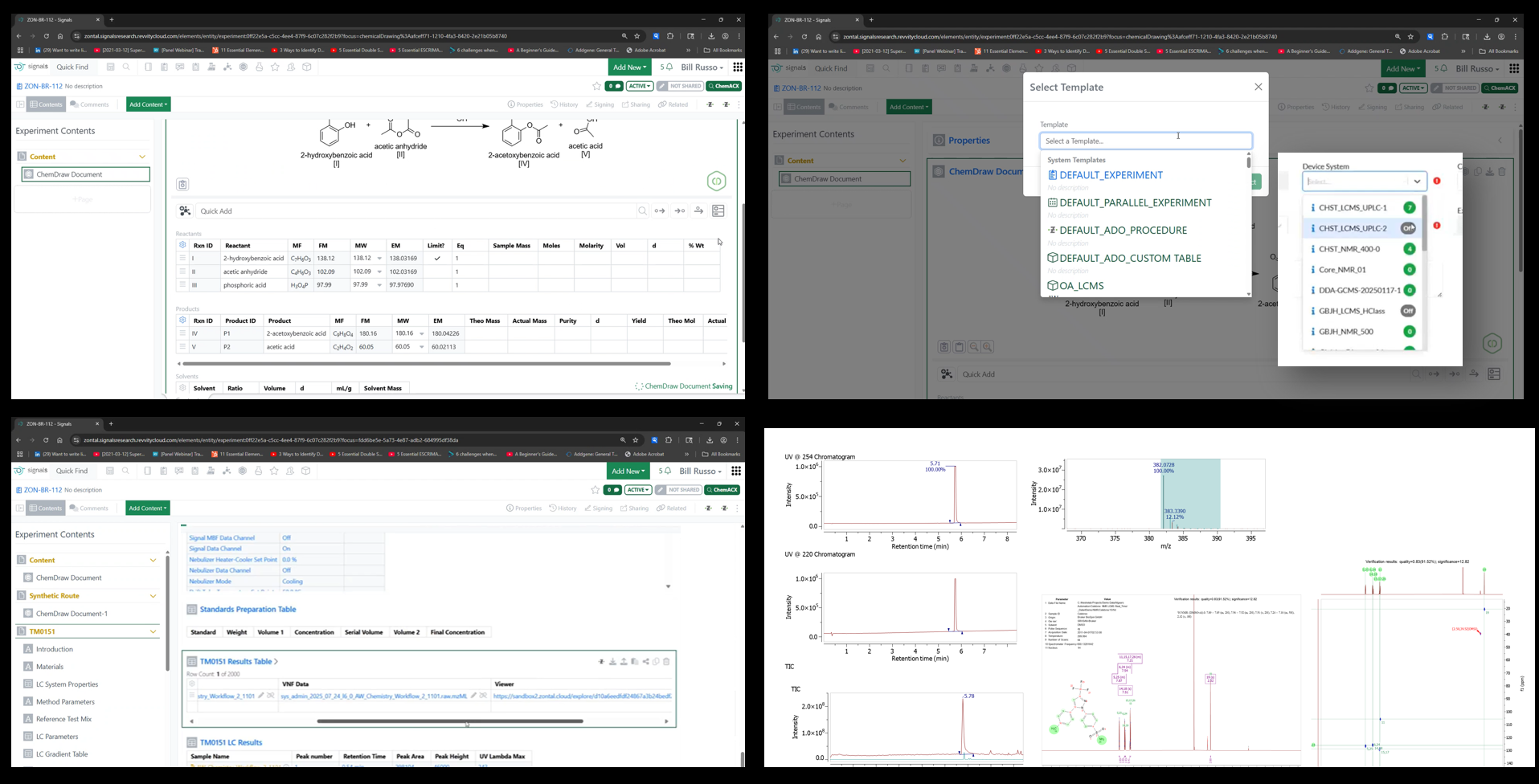
Four-panel view of ZONTAL Operations integrated with Revvity Signals ELN: experiment with ChemDraw reaction, template selection, device system list with NMR and LCMS instruments, and chromatography with MS results
ELN Integration — Revvity Signals ELN experiment with ChemDraw reaction (top left), ZONTAL template selection (top right), device system assignment with NMR and LC-MS instruments (top right), and chromatography + mass spectrometry results with peak identification (bottom).
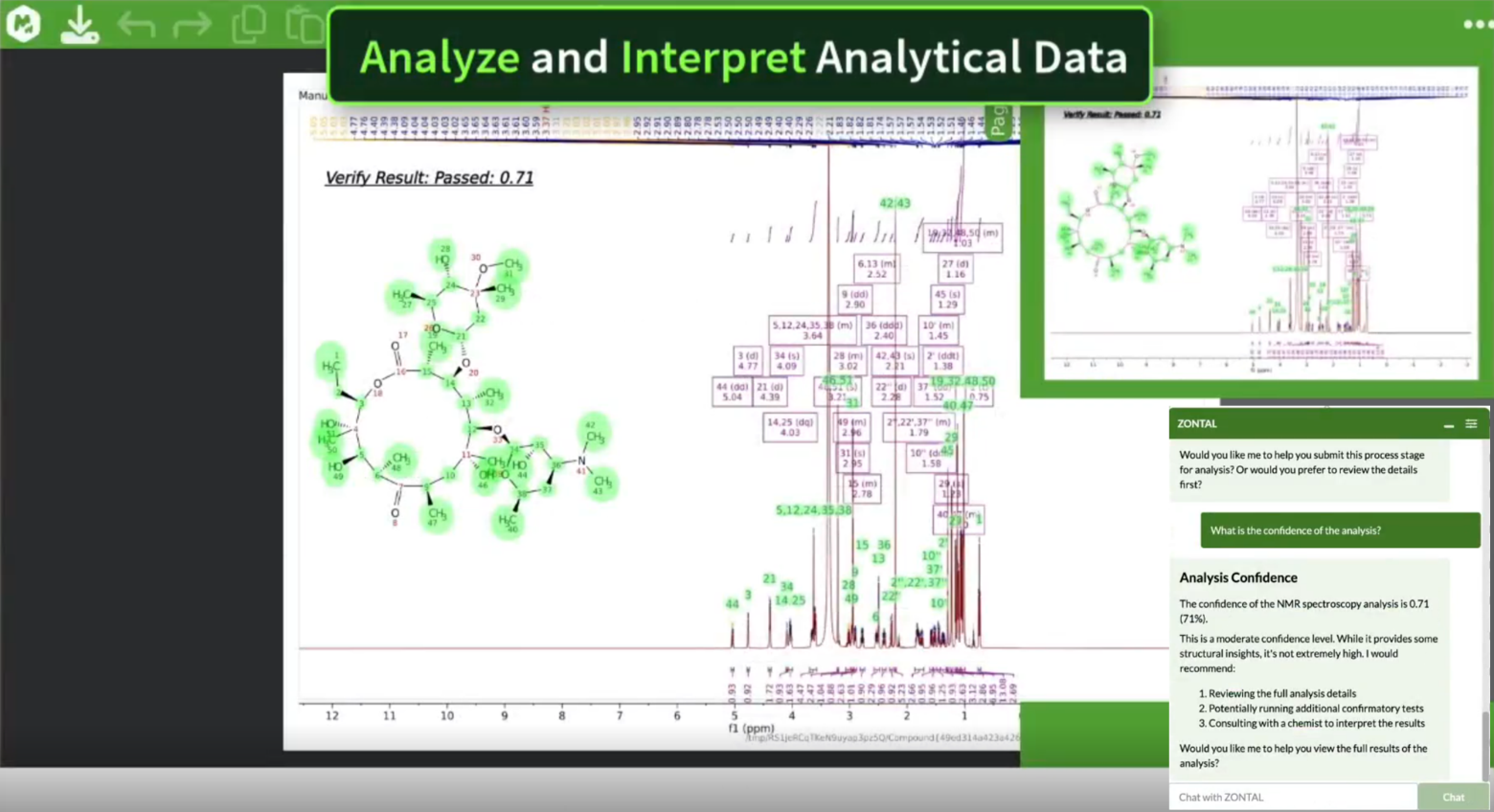
SciYNova NMR structure verification showing ¹H NMR spectrum with peak assignments, molecular structure overlay, Verify Result: Passed 0.71, and ZONTAL AI chat discussing analysis confidence
Automated Analysis — SciYNova processes the NMR spectrum, assigns peaks to the molecular structure, and returns a verification score (0.71). The ZONTAL AI assistant explains the confidence level and recommends next steps.
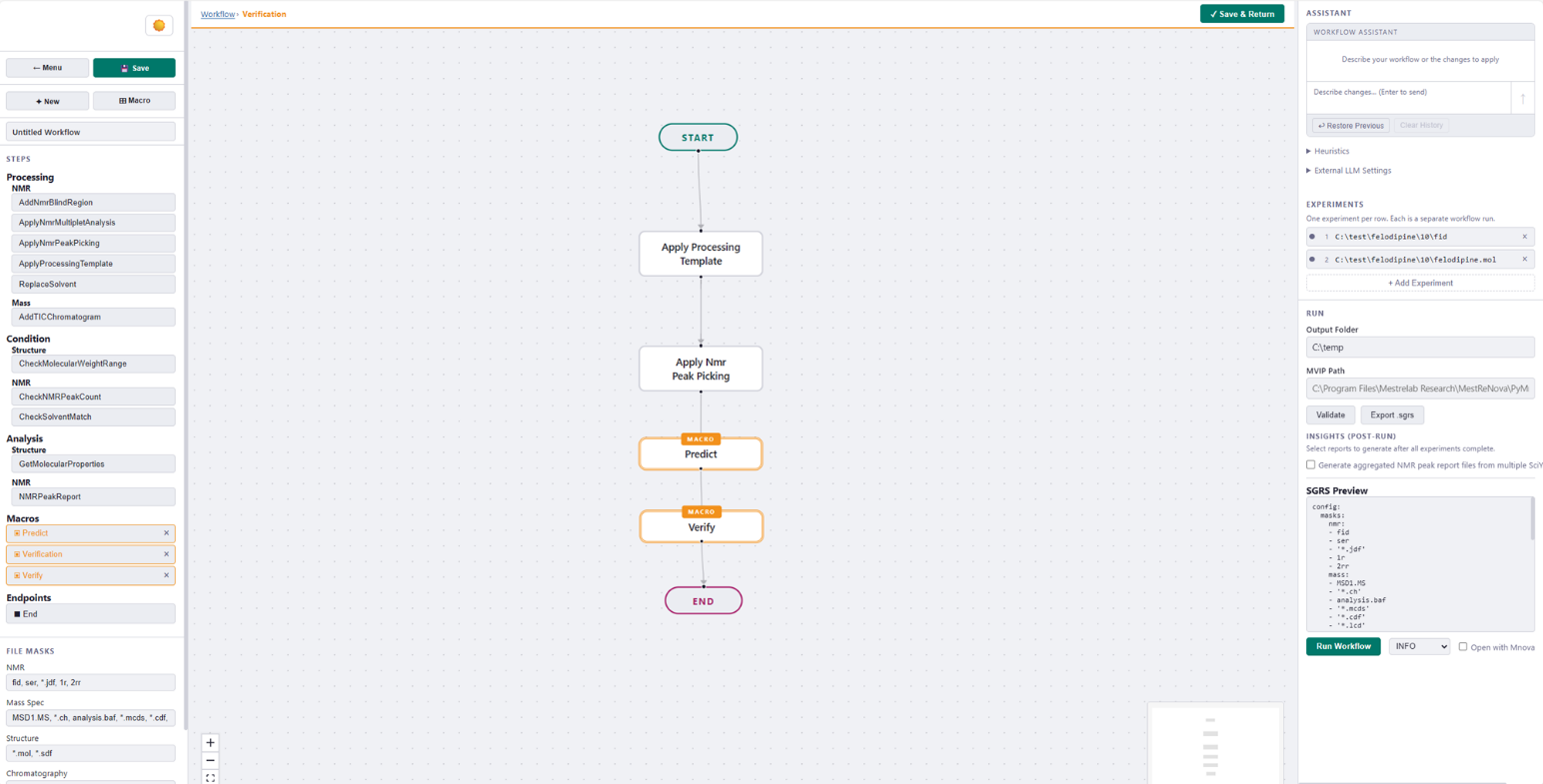
SciYGears workflow designer showing a Verification workflow: Start → Apply Processing Template → NMR Peak Picking → Predict → Verify → End, with NMR and mass spec file masks and SGRS configuration
SciYGears Workflow Designer — Visual composition of analytical processing pipelines. This verification workflow chains NMR processing, peak picking, prediction, and structure verification into a governed, repeatable automation template.
In Practice

End-to-End Workflows Running Today

These are not conceptual diagrams. Each workflow is deployed and running in pharmaceutical R&D labs — orchestrating sample flow, instrument acquisition, automated processing, and governed documentation across systems.

NMR + LC-MS Structure Verification

ELN → Acquisition → Auto-Processing → ELN

Synthetic chemist requests verification from ELN. ZONTAL drafts sample lists, schedules NMR and LC-MS instruments, acquires data, and triggers SciYGears auto-processing. Pass/fail evaluation runs automatically. On pass: results documented to ELN. On failure: auto-escalation to the analytical core team — high-resolution NMR and accurate MS/MS are queued, followed by SciYNova CASE-assisted structure elucidation and documentation.

Structure Verification Auto-Escalation CASE Elucidation

Chiral Purification Workflow

ELN → Screening → Prep Sep → QC → ELN

ELN request triggers chiral method screening with configurable scouting parameters. SciYGears evaluates screening results and selects the best method. Preparative chiral separation executes via synTQ liquid handling. Fraction lineage is tracked through collection, concentration, and LC-MS QC confirmation. Final results document back to ELN with complete parent–child–fraction provenance.

Method Screening Fraction Lineage synTQ Integration

X-Ray Absolute Structure Determination

ELN → Triage → Crystallization → XRD → ELN

ELN request initiates sample receipt and crystallinity triage via DSC and optical microscopy. If the sample lacks suitable crystals, the workflow branches to recrystallization screening. After crystal selection, XRD data collection and structure refinement proceed automatically. The complete parent–child lineage — from compound through crystal to refined absolute structure — is governed and documented.

Crystallinity Triage XRD Refinement Absolute Structure
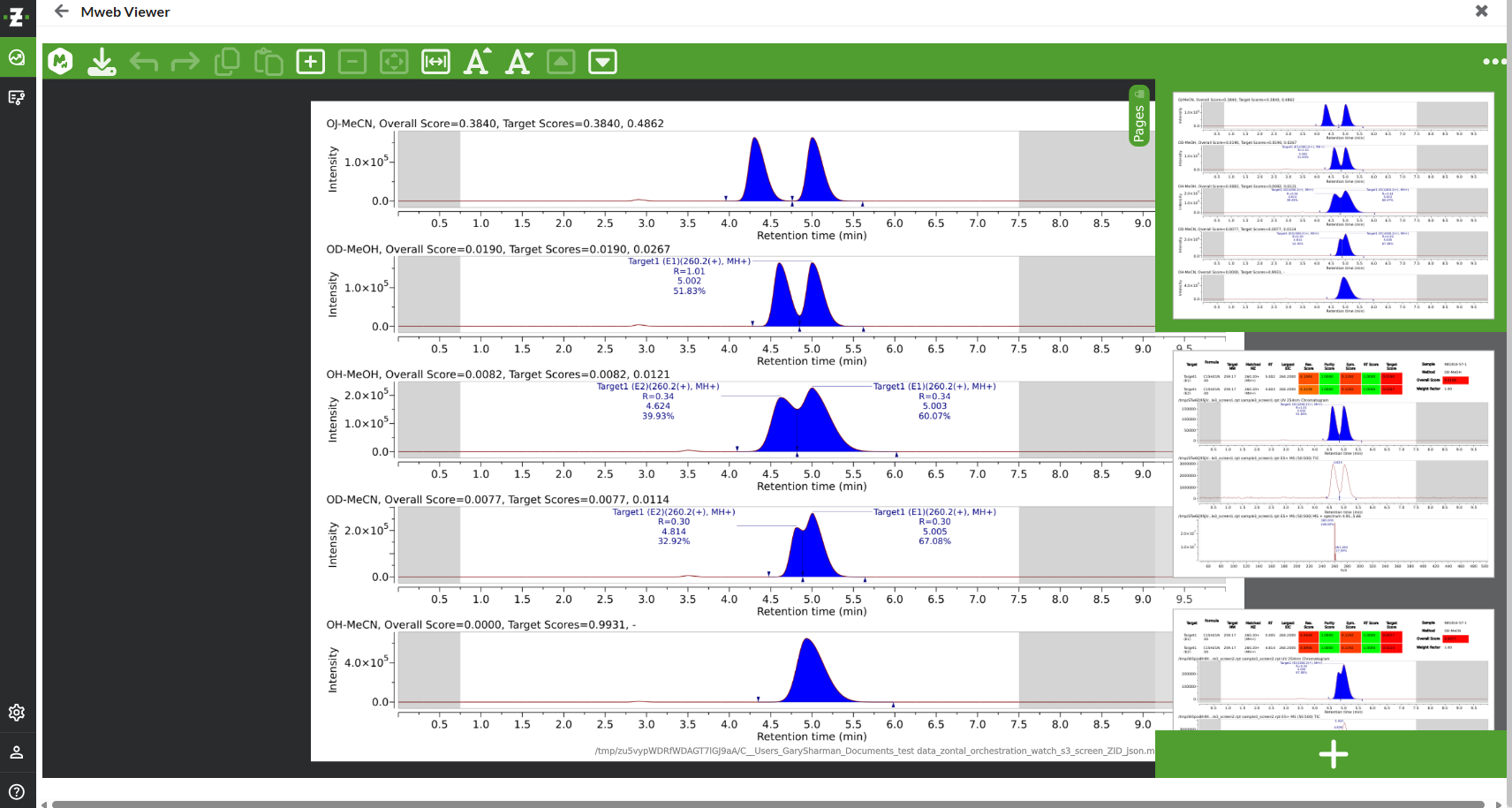
SciYNova Web chiral method screening results showing five column/solvent conditions (OJ-MeCN, OD-MeOH, OH-MeOH, OD-MeCN, OH-MeCN) with chromatograms, resolution scores, and enantiomeric ratios for each condition
Chiral Method Screening — SciYNova Web displays chromatograms for five column/solvent conditions with automated scoring. The best separation method is identified by overall score and enantiomeric ratio.
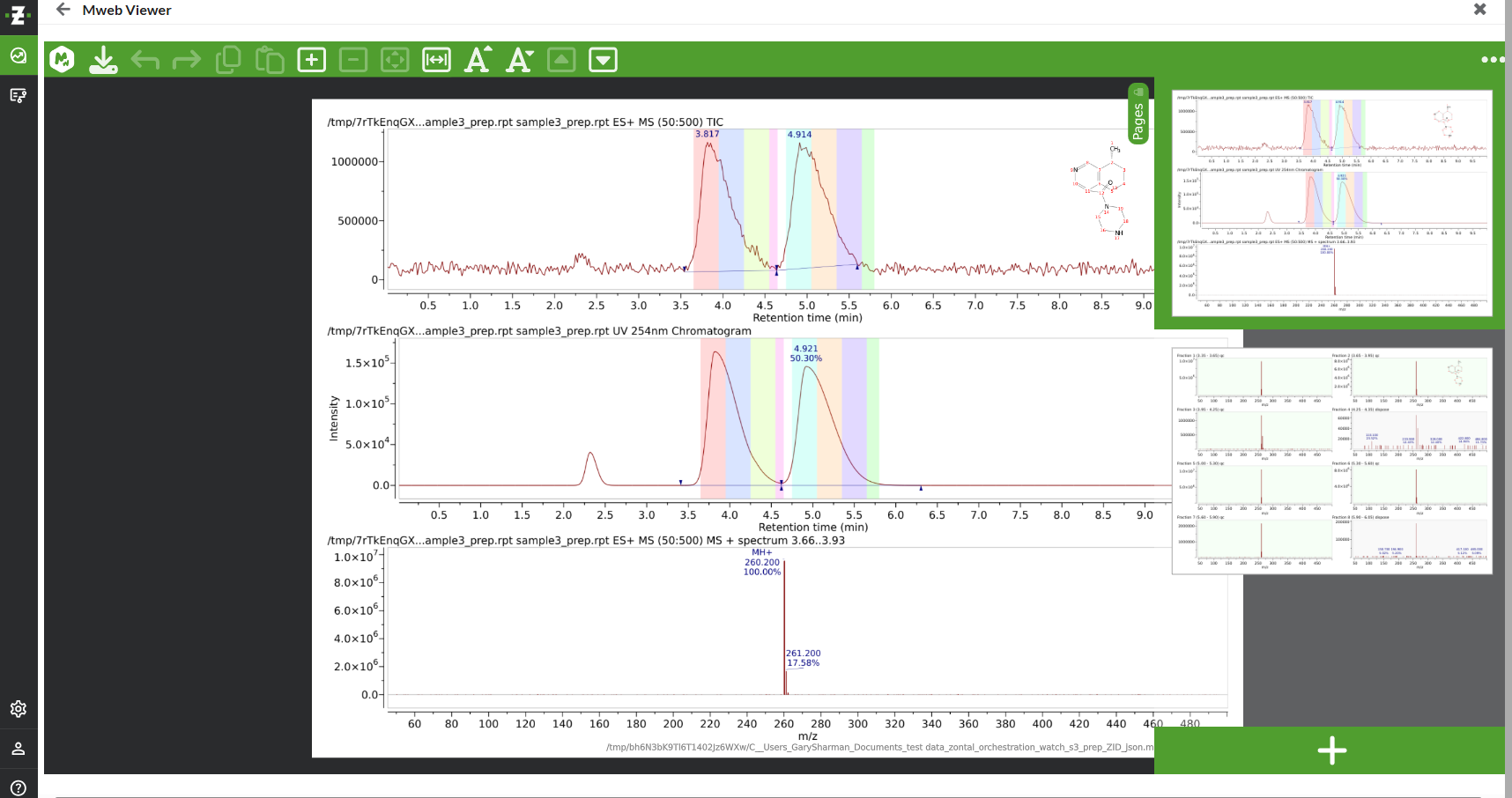
SciYNova Web preparative chiral separation showing TIC chromatogram with fraction collection windows highlighted in color, UV 254nm chromatogram, and ESI+ mass spectrum with MH+ 260.200 confirming target compound identity
Preparative Separation — TIC and UV chromatograms with fraction collection windows highlighted. Mass spectrum confirmation (MH+ 260.200) validates target compound identity in collected fractions.
Watch

Workflow Orchestration Demos

End-to-end workflow orchestration demos — from ELN request through instrument acquisition, automated analysis, and documented results.

Analytical Workflow Orchestration

ELN request triggers NMR and LC-MS acquisition, SciYGears auto-processing, pass/fail evaluation, and automatic result documentation — no manual handoffs.

ELN Integration and Sample Routing

Revvity Signals ELN experiment creates an analytical request. ZONTAL routes the sample to instruments, processes results, and documents back to the ELN.

End-to-End Lab Automation

Full walkthrough of the governed automation loop — from sample receipt through multi-instrument acquisition, auto-escalation, and final reporting.

Compound Effect

Principles Compounding to Enable Workflow Orchestration

ZONTAL Operations is not a standalone product — it draws on all four ICAD layers. Each principle compounds on the one before, and workflow orchestration requires all four working together.

Integrate

Instrument Connectivity

Operations schedules and acquires data from every connected instrument — NMR spectrometers, LC-MS systems, XRD diffractometers, plate readers, flow cytometers, thermal analyzers, and more — through governed integration factories. Without Integrate, each instrument requires manual file transfer and format conversion.

Contextualize

Scientific Context Graph

Sample lineage, parent–child–fraction relationships, and method–instrument associations are maintained in the governed context graph. Operations relies on this graph to route samples, link results to requests, and preserve provenance across workflow steps.

Analyze

Automated Processing & Intelligence

SciYGears auto-processing, spectral comparison, and pass/fail evaluation are Analyze capabilities that Operations invokes at each workflow decision point. Without automated analytical intelligence, branching logic has no data to branch on.

Decide

Configurable Oversight Model

Operations implements the Decide principle's oversight spectrum: fully automated pass/fail for routine measurements, supervised autonomy for complex escalations, and human-in-the-loop approval for regulatory-critical steps. The level of automation is configurable per workflow, per step, per organization.

Each Principle Compounds on the One Before

Workflow orchestration requires all four layers working together. Without governed integration, there is no instrument connectivity. Without scientific context, there is no sample lineage. Without analytical intelligence, there is no automated decision logic. Without configurable oversight, there is no trust.

Orchestrate Your Analytical Workflows

See how ZONTAL Operations transforms manual experiment coordination into governed, dynamic workflows — from ELN request through automated analysis to documentation.