ICAD Platform — Integrate

Integration Industrialization

First integration took weeks. The hundredth took days. The five-hundredth takes hours. Every instrument connected, every format converted, every metadata field enriched compounds the infrastructure for every integration that follows.

40%+ Faster per build
Weeks → Hours Integration timeline
AI-Assisted Converter generation

The innovations described in the content herein are subject to patent rights present within a global patent portfolio developed and managed for the benefit of ZONTAL. All rights reserved.

Production Evidence

The Foundation Proven at Scale

Production-grade products trusted by six of the top ten pharmaceutical companies. Data Preservation, Data Hub, Applications Hub, Technique Apps, and a growing Integration Catalog — the compound infrastructure that makes everything above possible.

Foundation

Data Preservation

The governed data store at the center of every ZONTAL deployment. Long-term storage with lifecycle management, electronic signatures, and provenance tracking at every transition.

  • Governed lifecycle: New → Submitted → Archived
  • Metadata enrichment and cataloging
  • Electronic and digital signature support
  • Role-based and attribute-based access control and audit trail
Interoperability

Data Hub

Convert and normalize instrument data beyond vendor limits. Delivers structured content into Data Preservation with ETL-free access — powering every downstream principle.

  • Proprietary-to-neutral format conversion
  • Vendor-agnostic data normalization
  • Semantic database with live query access
  • Zero-ETL architecture for downstream systems
Techniques

Applications Hub

Modular technique application framework. API support, custom visualizations, and regulated-environment deployment. Build once, deploy across the entire organization.

  • API-first modular architecture
  • Custom dashboard and visualization support
  • Regulated-environment deployment
  • Reusable application templates
Catalog

Integration Catalog

150+ vendors, 400+ instrument models, 8 core analytical techniques with 80+ variants. Searchable, growing continually as new integrations compound on existing ones.

150+ Vendors
400+ Models
100+ Techniques
Delivery

Integration Factories

AI-assisted integration delivery. Repeatable design, build, test, and deploy pipeline that turns new instrument connections from bespoke projects into predictable production releases.

  • AI-assisted converter generation
  • Standardized build-test-deploy pipeline
  • Automated regression testing
  • Predictable delivery economics
Workflow Orchestration

Fleet Management

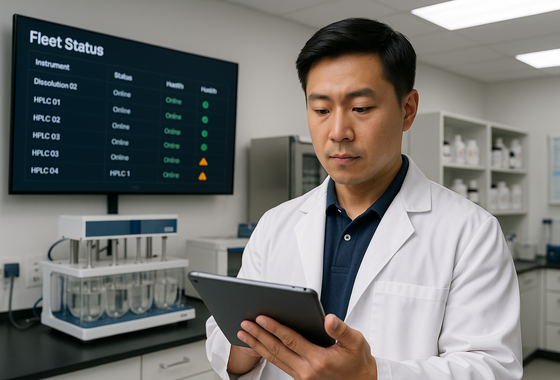
Operational monitoring at scale. Health meters, ingest trending, failure root-cause analysis — real-time visibility across your entire instrument fleet.

  • Multi-site device monitoring
  • Ingest rate trending and alerting
  • Failure root-cause analysis
  • Service health dashboards
Technique Applications

Each application connects specific instrument families to the ZONTAL platform — purpose-built converters, metadata models, and visualizations for every analytical technique.

Chromatography

HPLC, UPLC™, GC, IC

Mass Spectrometry

LC-MS, GC-MS, ICP-MS

NMR Spectroscopy

1D, 2D, multinuclear

Flow Cytometry

Multi-parameter cell analysis

Plate Reader

Absorbance, fluorescence, luminescence

DVS

Dynamic Vapor Sorption

Thermal Analysis

DSC, TGA, DMA

XRD

X-Ray Diffraction

UPLC is a trademark of Waters Corporation. All other trademarks are the property of their respective owners.

What Your Data Unlocks

Capabilities Enabled by the Compound Foundation

The existing integration infrastructure enables new capabilities that were impossible before — AI-assisted converter generation, factory economics that improve with every build, and fleet-wide operational visibility.

Integration Factories

AI-assisted converter generation and adapter authoring. Upload raw vendor output, AI drafts the conversion mapping, an engineer reviews, and the validated converter deploys. Every build makes the next one faster.

  • AI-assisted format analysis and mapping
  • Engineer-reviewed validation pipeline
  • Reusable converter components that compound
  • Automated regression testing on deployment

Fleet Dashboard

Operational monitoring at enterprise scale. Health meters, ingest trending, and failure root-cause analysis across your entire instrument fleet — from a single pane of glass.

  • Real-time device health across all servers
  • Ingest volume trending and anomaly detection
  • Automated failure root-cause analysis
  • Service-level monitoring and alerting

Factory Economics — The Compound Curve

Every integration built compounds on the existing infrastructure. Shared parsers, validated patterns, and reusable components mean each subsequent converter takes less effort than the last.

100%

First in Class

Full build from scratch — new converter, new metadata model, new visualization

60%

Second Variant

Reuses core parser — only variant-specific fields and edge cases remain

35%

Third Variant

Pattern library handles most mapping — engineer focuses on validation

<20%

Fifth+ Variant

AI-assisted draft, minor review — marginal effort approaches zero

Hardware-Independent Validation

Every instrument adapter includes a built-in simulation mode. The same adapter that runs against production hardware can replay OPC UA and SiLA 2 protocol behavior on an engineering workstation. The entire design → build → verify cycle runs without reserving lab time. Hardware commissioning becomes a focused final step — not a multi-week prerequisite.

How simulation mode works →
Watch

Converter Factory — from Vendor File to Self-Describing Data Asset

See the full converter lifecycle: format submission, automated conversion, test validation, and governed approval.

Who This Serves

Built for the Teams That Connect Instruments to Science

Lab Informatics Manager

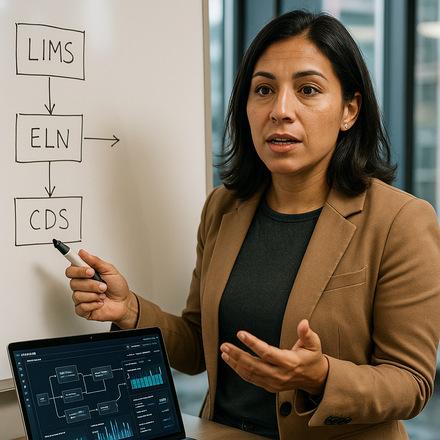
Manages instrument connections across multiple LIMS, ELN, and dozens of vendor formats. Every new instrument model means a new bespoke integration project that takes weeks and requires vendor-specific knowledge nobody else on the team has.

QC Lab Supervisor

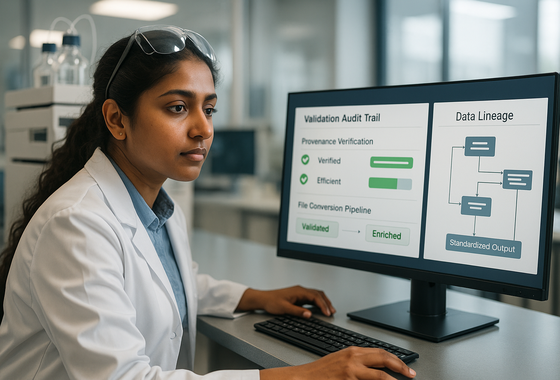
Responsible for ensuring 40+ instruments across two manufacturing sites produce governed, audit-ready data. Format inconsistencies between vendor software versions create reconciliation work before every batch release.

Automation Engineer

Builds and maintains instrument-to-system data pipelines, but each new protocol or OPC UA endpoint requires custom scripting — no reusable components, no simulation mode, and hardware commissioning blocks the entire validation timeline.

How Integrate Feeds Contextualize

Every instrument connected, every data format converted, every metadata field enriched flows into the scientific context graph. The more instruments you connect, the richer the lineage, the more powerful the intelligence above.

Every integration you build today trains the AI you deploy tomorrow. AI models require governed, validated scientific data — not raw instrument files. Integrate is where AI readiness begins.

Integrate

Integration Industrialization

Raw instrument data extracted, converted, and enriched with metadata beyond vendor limits

Contextualize

Scientific Context & Lineage

Context graph linking portfolio, materials, analytical, and infrastructure data

Your ZONTAL Journey

Integrate establishes the CONNECTED stage — the foundation that makes every subsequent stage possible. Your instruments are connected, your data flows, your integration infrastructure compounds.

1

Connected

Instruments integrated, data flowing, metadata enriched

2

Contextual

Scientific context graph linking all data domains

3

Intelligent

Accelerated investigations and tech transfer

4

Autonomous

Portfolio intelligence, AI decisions, supervised automation

Each Principle Compounds on the One Before

Integration industrialization is the foundation that makes context, intelligence, and AI-enabled decisions possible. Without governed data flow, the principles above produce noise, not insight.

“I still cannot believe we’re still having printed copies of analytical methods to do method transfer across labs — or even partners and CROs.”

Azzedine Dabo, Principal Scientist, GSK

Ready to Accelerate Your Integration Infrastructure?

See how the compound integration model connects your instruments, converts your data, and builds infrastructure that gets faster with every integration.