
Executive Summary
The Problem
Pharmaceutical R&D generates scientific data at unprecedented scale - from instrument measurements and assay results to stability studies and regulatory filings. A decade after the FAIR principles (Wilkinson et al., 2016) gave the industry a shared vocabulary for data quality, most organizations can find their data. Few can act on it.
The gap is operational. FAIR describes properties of data at rest - findable, accessible, interoperable, reusable. It does not define how raw scientific output becomes governed, contextualized, analyzable intelligence that drives decisions at enterprise scale. The result: analytical data remains trapped in instrument silos, scientific context lives in PDF reports and ELN narratives, and cross-program insights require weeks of manual assembly by subject matter experts who are already the bottleneck.
This operational gap costs the industry years of development time and billions in unrealized value. Patent cliffs, pipeline pressure, and regulatory complexity are accelerating - yet the evidence infrastructure that should fuel faster decisions remains fragmented across vendors, sites, formats, and systems.
The ICAD Vision
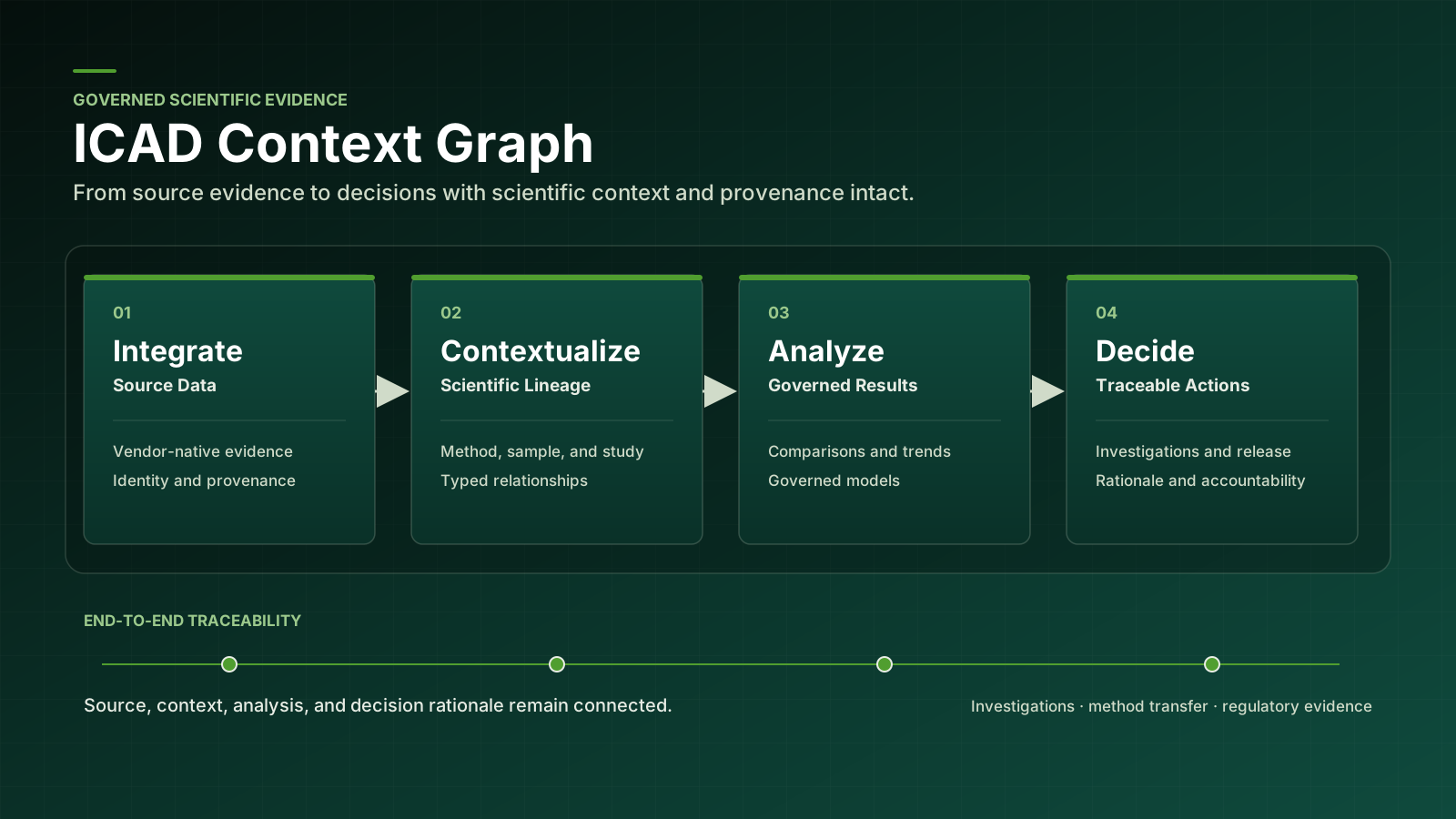
The ICAD Principles - Integrate, Contextualize, Analyze, Decide (Colsman, 2026a) define the operational sequence that transforms raw scientific output into governed, AI-ready intelligence. Unlike FAIR, which defines independent properties, ICAD defines a compounding sequence: each step builds on the one before it and makes the next one more valuable.
- Integrate - Connect every scientific data source to a governed pipeline. Capture at the point of creation. Industrialize the integration process so each new source onboards faster than the last.
- Contextualize - Link data to its scientific meaning - method, sample, experiment, study, program, and regulatory submission. Reconcile master data across sites and systems. Maintain bidirectional lineage from source to decision.
- Analyze - Operate on contextualized data, never on raw output alone. Govern cross-program comparisons with consistent methods and statistical frameworks. Ensure models are traceable and results are reproducible.
- Decide - AI operates only on data that has passed through I→C→A. Every decision is traceable to its source data and decision logic. Autonomy is configurable per decision type and risk profile.

The sequential dependency is the defining property: you cannot contextualize data you have not integrated, analyze data you have not contextualized, or make trustworthy decisions from ungoverned analysis. This creates a compounding return - integration 50 makes the entire dataset more valuable than integration 1 did, because every new data source enriches the context, sharpens the analysis, and improves the decisions.
This white paper describes the context graph - the structural model that makes ICAD's Contextualize principle concrete. It presents an extended Connected Domains architecture that organizes semantic domains into three composition tiers and adds governed Evidence Outputs and Implementation Surfaces (Colsman, 2026b). It maps these to the ontological initiatives that provide their semantic grounding, and demonstrates how this architecture transforms FAIR-compliant data into decision-ready intelligence.
1. FAIR Is Necessary but Not Sufficient
The FAIR principles (Wilkinson et al., 2016) established that scientific data should be Findable, Accessible, Interoperable, and Reusable. Every major pharmaceutical company has FAIR data management plans filed with funding agencies and regulatory bodies. These principles succeeded in creating a shared vocabulary for data quality.
But FAIR is silent on what happens next. How does a FAIR-compliant chromatogram become part of a stability trend? How does a FAIR-compliant assay result connect to the method that produced it, the specification it is judged against, and the regulatory submission it supports? FAIR assumes the operational infrastructure exists. In most organizations, it does not.
The ICAD publication defines this distinction precisely:
"FAIR describes what scientific data should be. ICAD defines how it drives decisions at scale."
Colsman (2026), The ICAD Principles, p. 2
FAIR principles are independent - you can make data Findable without making it Accessible. ICAD principles are sequential and compounding. Integration that has been contextualized is exponentially more valuable than raw integration. Analysis built on contextualized data is exponentially more reliable than analysis on raw feeds. Decisions from governed analysis are exponentially more trustworthy than decisions from ungoverned models.
The 16 ICAD sub-principles (I1–I4, C1–C4, A1–A4, D1–D4) operationalize each stage with concrete requirements, operational tests, examples, and antipatterns. Of particular relevance to this white paper are the Contextualize sub-principles:
| Sub-Principle | Requirement |
|---|---|
| C1 | Data is linked to its scientific context - method, sample, experiment, study, program, and regulatory submission |
| C2 | Master data is reconciled across sites, systems, and naming conventions - one identity per entity, globally |
| C3 | Lineage traces every data point from instrument through transformation to decision, with no gaps |
| C4 | Context is readable by scientists and machines - not trapped in PDF reports, ELN narratives, or spreadsheet column headers |
These four sub-principles define what a context graph must achieve. The domain models presented in Section 3 provide the structural vocabulary; the ontological ecosystem described in Section 4 provides the semantic grounding.
2. The Context Graph: Making Contextualization Structural
ICAD's Contextualize principle (C1–C4) requires that every data point is linked to its full scientific context. But “scientific context” is not a flat namespace - it is a graph of interconnected domains with compositional relationships.
A single analytical result exists in a web of context: the method that prescribed how the measurement was performed, the sample that was measured, the material from which the sample was derived, the instrument that produced the raw signal, the specification against which the result is judged, the experiment that organized the measurement campaign, the study that aggregates experiments toward a scientific question, and the regulatory submission that presents the evidence to an authority.
This web of relationships is the context graph - a typed, navigable structure where every node is a domain-specific document and every edge is a semantic relationship grounded in formal ontology.
2.1 From Document Models to Context Graph
The Allotrope Simple Model (ASM) provides the structural building blocks. ASM defines eight domain-agnostic structural patterns - aggregate, indexed, value, quantity, class, category, binary, and datacube datum - that compose into Document Models for specific domains. These patterns are not domain-specific; they are the grammar of scientific data representation.
The context graph emerges when these Document Models are connected through typed references. A result document references a method document. A method document references material documents and specification documents. A test document orchestrates analytical documents and references instrument documents. The graph is not imposed after the fact - it is inherent in the schema structure.
2.2 Structural Patterns as a Shared Grammar
Six patterns recur across all domain models in the Connected Domains architecture (Colsman, 2026b), establishing a consistent structural grammar:
| Pattern | Purpose | Origin |
|---|---|---|
category datum with $asm.value-instance-of |
Closed enumerations (verdicts, status types) - constrained to named individuals of a specific ontology class | Technique schemas, Method schema |
class datum with $asm.value-sub-class-of |
Open taxonomies (equipment classes, technique types) - any subclass of a given ontology class | Technique schemas, Method schema |
| reference aggregate document | Typed cross-domain references with version, role, and lifecycle metadata | Method schema |
| objective specification aggregate document | Acceptance criteria - lower limit, upper limit, specification assessment | Method schema |
| life cycle status + version log | Document versioning with effective dates, authors, and change tracking | Method schema |
| Aggregate → document[] | Every root aggregate document contains a typed document array as its first child | All ASM schemas |
These patterns are defined by the Connected Domains Candidate Release (CR 2026/06). Together with the structural patterns established by the 50+ technique schemas (the Results and Analytical domains), they ensure that the context graph has uniform traversal semantics regardless of domain.
3. The Connected Domains Architecture
The proposed context graph organizes 15 semantic domains in three composition tiers, complemented by governed Evidence Outputs and Implementation Surfaces. A cross-cutting Master and Reference Data foundation supports the complete architecture. Each composition tier builds on the one below it, mirroring ICAD's compounding principle at the structural level. Evidence Outputs and Implementation Surfaces are parallel views that reference and consume domain data without forming additional composition layers. Every domain model maps onto the Basic Formal Ontology (BFO, ISO/IEC 21838-2), which divides reality into continuants (entities persisting through time) and occurrents (entities unfolding in time), giving each node in the context graph a formally grounded ontological category.
3.1 Tier 1 - Atomic (Identity and Data Primitives)
Atomic hierarchies represent entities that exist independently - they carry identity and data without depending on other domains for their definition.
| Artifact Model | BFO Category | Description |
|---|---|---|
| Materials | material entity (continuant) | Material identity, composition, grade, specification, supplier. Persists across the enterprise. |
| Samples | material entity + obi:specimen role | Specimen identity, provenance, preparation history, physical/chemical properties. |
| Analytical | planned process (occurrent) | The realized data-acquisition event: selected method version, actual parameters, instrument configuration, timestamps, observations, and deviations from the prescribed plan. ASM's current core. |
| Results | generically dependent continuant (IAO data item) | Processed outcomes: calculated values, peak tables, fitted models. Distinguished from raw analytical data by interpretation. |
| Methods | generically dependent continuant (IAO action specification) | The prescriptive plan for how to perform an analysis: procedure hierarchy, parameters, equipment capabilities, calculations, and system-suitability controls. The Digital Analytical Method schema. |
| Specifications | generically dependent continuant (IAO objective specification) | The approved set of test definitions, referenced analytical procedures, and acceptance criteria for required material or product quality attributes. Acceptance criteria are components of the specification, not synonyms. |
| Instruments | material entity (continuant) | Equipment designed primarily to make measurements or observations. The model keeps class/model identity separate from each serial-numbered physical asset. |
| Equipment | material entity (continuant) | Assets whose primary purpose is preparation, processing, containment, control, or environmental conditioning. Class/model and physical instance remain separate dimensions. |
3.2 Tier 2 - Compositional (Orchestration)
Compositional hierarchies organize atomic elements into structured workflows. They do not produce data themselves - they orchestrate the entities that do.
| Surface Model | BFO Category | Description |
|---|---|---|
| Tests | plan specification + planned process + data item | A test definition names the material attribute, applicability, approved method options, and any criteria. A test execution applies one selected method version to a sample and produces a result; conformance assessment is separate and optional. |
| Experiments | planned process (occurrent) | A planned investigation combining procedures, interventions, preparations, controls, observations, analytical determinations, and interpretation to answer a scientific question. |
| Procedures (ISA-88) | plan specification (IAO) | Procedural hierarchy - unit procedure → operation → phase. Equipment-independent process definition. |
| Recipes (ISA-88) | plan specification (IAO) | General, site, master, and control recipes progressively bind procedures and formulas to materials, site capabilities, equipment, and batch-specific resources. |
3.3 Tier 3 - Systemic (Aggregation)
Systemic hierarchies aggregate compositional elements into scientific and regulatory structures.
| Domain | BFO Category | Description |
|---|---|---|
| Studies | investigation (OBI, occurrent) | Multi-experiment scientific inquiry - study design, arms, endpoints, outcomes. ICH-aligned stability studies, bioequivalence studies. |
| Projects | planned process (occurrent) | An approach or compound pursued within a Program; groups related Studies by modality or therapeutic objective. |
| Programs | planned process (occurrent) | The highest-level objective. A Program may contain Projects and direct Studies and may cover discovery Research Operating Plans, preclinical, clinical, CMC, lifecycle, or quality work. Regulatory context is optional. |
3.4 Evidence Outputs (parallel view)
Evidence Outputs are structured artifacts that reference and assemble data from the three semantic tiers. They are not composition layers - they govern how scientific evidence is interpreted, communicated, submitted to authorities, and used in decisions.
| Domain | BFO Category | Description |
|---|---|---|
| Scientific Interpretations | generically dependent continuant (IAO data item) | Independently addressable scientific claims or conclusions linked to their subject, scope, evidence, analysis method or model, assumptions, alternatives, uncertainty, author or generating agent, review status, provenance, and supersession history. |
| Scientific Reports | generically dependent continuant (IAO report) | Governed communication artifacts with a defined purpose, audience, ordered sections, evidence and interpretation references, authorship, review, approval, issuance, amendment, and supersession. Subtypes include analytical, study, validation, investigation, and technical reports and Certificates of Analysis. |
| Regulatory Submissions | generically dependent continuant (IAO document) | CTD/eCTD structures - Module 3 (Quality), Module 4 (Nonclinical), Module 5 (Clinical). Uses eCTD section/subsection hierarchy as backbone, with references to atomic/study ASMs rather than duplicated content. |
| Decision Records | generically dependent continuant (IAO data item) | Structured records of decisions: question, evidence inputs, rule/rationale, actor (human or model), timestamp, outcome, confidence/status, and full lineage. |
3.5 Implementation Surfaces (enterprise system consumers)
Implementation Surfaces are the enterprise information systems that consume, orchestrate, and present data from all three semantic tiers. They are described here because their data models constrain how domain data is surfaced.
| Domain | BFO Category | Description |
|---|---|---|
| ELN | generically dependent continuant (IAO document) | Electronic Laboratory Notebook - narrative plus structured sections, typed fields, tables, properties, attachments, decisions/reasoning, signatures, and IP evidence. |
| LIMS | planned process + data item | Laboratory Information Management System - preserves typed lineage from sample registration through test definition, method version, execution, result, conformance assessment, review, and decision. |
| MES | planned process (occurrent) | Manufacturing Execution System - batch records, in-process controls, environmental monitoring, equipment utilization. ISA-88/ISA-95 aligned. |
| ERP | planned process (occurrent) | Enterprise Resource Planning - production scheduling, material master, cost management. The outermost integration boundary. |
| Operational Technology | planned process (occurrent) | SCADA, DCS, PLC, and process historians (ISA-95 Levels 0–2). Subtypes within a single domain, not separate semantic domains. Provides time-series environmental and process data. |
3.6 Cross-Cutting Master and Reference Data
Master and Reference Data is a foundation beneath every tier and view, not another domain layer. It supplies authoritative identifiers, governed vocabularies, stewardship, effective dating, versioned mappings, and identity reconciliation for materials, products, methods, devices, sites, organizational units, and units of measure. Consistent schemas cannot create interoperability when the records entering them use unresolved identities or conflicting terms. This foundation operationalizes ICAD C2 across the architecture.
3.7 The Architecture as a Context Graph
The semantic tiers, Evidence Outputs, Implementation Surfaces, and Master and Reference Data foundation form the complete context graph:
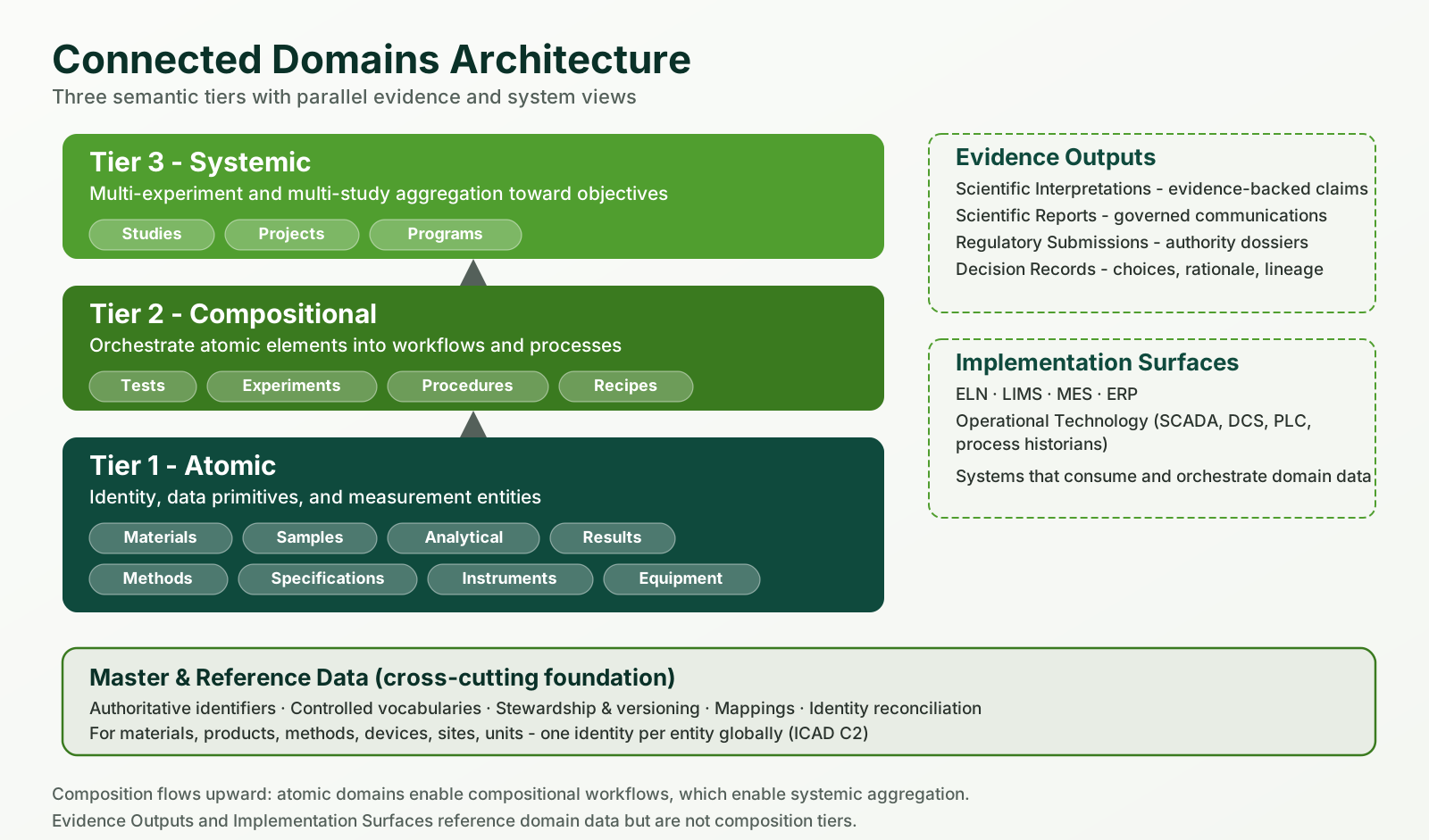
This is not a theoretical taxonomy. It is the structure that ICAD's C1 sub-principle requires: "Data is linked to its scientific context - method, sample, experiment, study, program, and regulatory submission." The three semantic tiers enumerate every domain node type in that context chain; Evidence Outputs show how evidence becomes interpretations, reports, submissions, and decisions, while Implementation Surfaces show where those structures are recorded and governed.
4. The Allotrope Connected Domains Model
The Allotrope Foundation's Connected Domains initiative, presented by Wes Schafer at the Spring 2026 Allotrope Connect Workshop in Leiden (Schafer, 2026), initially proposed seven core domains as the foundation for interconnected ASM schemas. The Q2 2026 Candidate Release (CR 2026/06) expanded scope to span Tiers 1 through 3 - from Programs and Studies through Experiments to analytical results, specifications, and reporting. The seven original domains proposed by Schafer are summarized below:
| Connected Domain | Tier | Status |
|---|---|---|
| Materials | 1 - Atomic | Proposed |
| Results | 1 - Atomic | Current ASM core |
| Methods | 1 - Atomic | Digital Analytical Method (CR 2026/06) |
| Specifications | 1 - Atomic | Proposed |
| Instruments | 1 - Atomic | Proposed |
| Equipment | 1 - Atomic | Proposed |
| Processes | 2 - Compositional | Proposed |
The Connected Domains model enables cross-domain ASM documents - for example, a stability study ASM linking material identity → method specification → instrument configuration → analytical results → specification comparison. This is the structural realization of ICAD's Contextualize principle: scientific data connected to its full operational context through typed, navigable schema relationships.
The extended Connected Domains model (Colsman, 2026b) positions the Allotrope initiative within the broader enterprise context. The Connected Domains model (CR 2026/06) now spans Tiers 1 through 3, covering atomic data primitives, compositional workflows, and systemic aggregations. The extended model additionally describes Evidence Outputs (Scientific Interpretations, Scientific Reports, Regulatory Submissions, Decision Records) and Implementation Surfaces (ELN, LIMS, MES, ERP, Operational Technology). Master and Reference Data provides the cross-cutting foundation rather than another model. These additions are currently outside the Allotrope initiative’s scope.
4.1 The Pistoia Alliance Digital Analytical Methods Project
At the same Spring 2026 Allotrope Connect Workshop, Birthe Nielsen (Pistoia Alliance) and Vinny Antonucci (MSD) announced a new Pistoia Alliance project: Digital Analytical Methods (Nielsen & Antonucci, 2026). This project, developed in collaboration with the Allotrope Foundation, aims to modernize how analytical methods are defined and used - shifting from manual, document-based method definitions to standardized, machine-readable method definitions that integrate directly with laboratory systems.
Building on the Methods Hub project, the Digital Analytical Methods initiative expands scope to include materials, specifications, sample preparation, system suitability, and external references for a more complete digital method model. This directly supports ICAD's C1 sub-principle - linking analytical data to its method context in a machine-readable form.
5. The Ontological Ecosystem
The context graph requires semantic grounding - formal ontologies that define what the nodes and edges mean. The pharmaceutical and life sciences community has built a rich ecosystem of ontologies aligned to the Basic Formal Ontology (BFO, ISO/IEC 21838-2), providing the semantic layer for each tier.
5.1 Foundation Ontologies
| Ontology | Scope | Relevance |
|---|---|---|
| BFO (Basic Formal Ontology) | Top-level: continuant/occurrent distinction | Every domain model maps to BFO categories |
| IAO (Information Artifact Ontology) | Information entities: documents, data items, specifications | Methods, specifications, results, regulatory documents |
| OBI (Ontology for Biomedical Investigations) | Investigations, assays, specimens, instruments | Analytical, samples, experiments, studies |
| AFO (Allotrope Foundation Ontology) | Analytical techniques, materials, instruments, results | ASM's native semantic layer across all domains |
5.2 Domain-Specific Ontologies
| Ontology | Domain Tier | Scope |
|---|---|---|
| ChEBI | Tier 1 (Materials) | Chemical substance types, molecular entities |
| QUDT | Tier 1 (Results) | Units of measurement, quantity kinds, dimensional analysis |
| ISA-88 / IEC 61512 | Tier 2 (Procedures, Recipes) | Procedural control model: unit procedure → operation → phase |
| ISA-95 / IEC 62264 | Implementation Surfaces (MES, ERP, OT) | Enterprise-control integration: Levels 0–4 |
| ICH Q1–Q14 | Tier 3 (Studies, Submissions) | Pharmaceutical quality guidelines: stability, validation, specifications |
5.3 Pistoia Alliance Ontologies
The Pistoia Alliance maintains two ontology initiatives of direct relevance to the context graph:
IDMP Ontology (IDMP-O): The pharmaceutical industry's implementation layer for the ISO Identification of Medicinal Products (IDMP) standards (ISO 11238, 11239, 11240, 11615, 11616). IDMP-O provides a shared, machine-readable framework for medicines data - substances, specified substances, ingredients, dose forms, units of presentation, and pharmaceutical products. As of May 2026, the ontology is maintained through a three-year engineering partnership with Accurids, with quarterly releases and a Steering Committee of leading pharmaceutical organizations shaping technical direction (Pistoia Alliance, 2026a).
IDMP-O maps directly to the Tier 1 Materials hierarchy - providing the substance identity and pharmaceutical product classification that materials documents reference. When a material document identifies a compound, the IDMP-O provides the globally harmonized identity that ICAD's C2 sub-principle requires: “one identity per entity, globally.”
CMC Process Ontology (CMC-PO): Presented by Birthe Nielsen at the Spring 2026 Allotrope Connect Workshop, the CMC Process Ontology provides a standardized, machine-readable representation of Chemistry, Manufacturing, and Controls (CMC) processes and their execution context (Nielsen, 2026). Its scope is explicitly process-centric and aligns with ISA-88 recipe structures. The ontology supports interoperability, tech transfer, data integration, and advanced analytics by enabling structured exchange of recipe and process data across systems and sites.
CMC-PO maps directly to the Tier 2 Procedures and Recipes hierarchies - providing the semantic vocabulary for the ISA-88 procedural control model that these Document Models implement. When a recipe document specifies a unit procedure, the CMC-PO provides the process classification and parameter semantics.
5.4 Ontological Layering Strategy
At the Spring 2026 Allotrope Connect Workshop, Rajaram Kaliyaperumal (J&J) presented a layered ontology strategy for managing the integration and extension of community ontologies within an enterprise (Kaliyaperumal, 2026). This approach uses community-developed ontologies (AFO, IDMP-O) as the base layer, with custom extensions addressing specific internal requirements - ensuring interoperability while scaling ontology development across stakeholders.
This layered strategy maps directly to the context graph's ontological architecture:
- Layer 1 - Foundation: BFO, IAO, OBI (universal categories)
- Layer 2 - Community: AFO, IDMP-O, CMC-PO, ChEBI, QUDT (domain semantics)
- Layer 3 - Enterprise: Organization-specific extensions (site nomenclature, internal classifications)
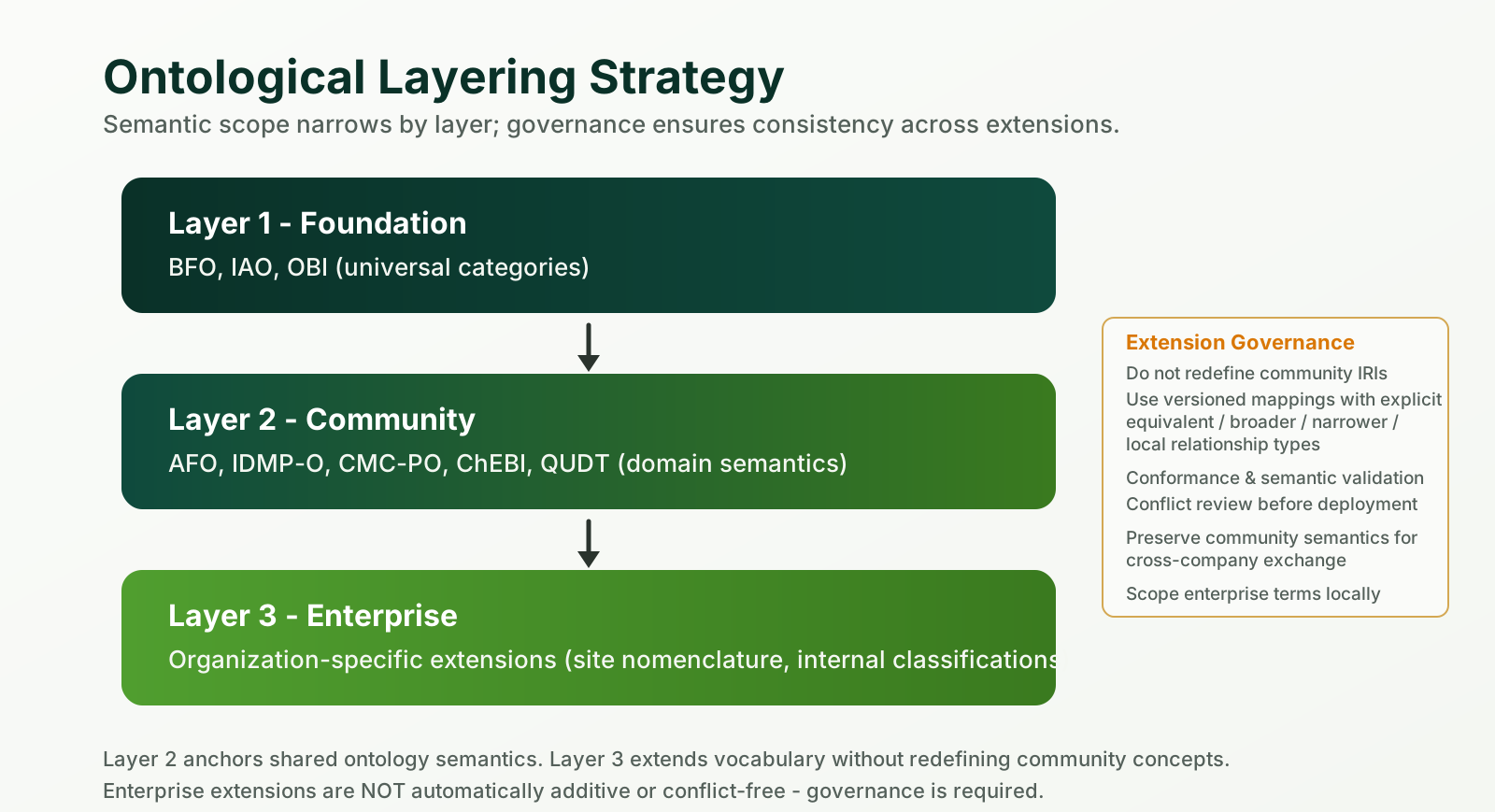
Each layer narrows the semantic scope, but enterprise extensions are not automatically additive or conflict-free - governance is required. Enterprise extensions must not redefine community IRIs; they should use versioned mappings with explicit equivalent, broader, narrower, or local relationship types. Conformance and semantic validation must be applied before deployment, with conflict review to preserve community semantics for cross-company exchange. Enterprise terms should be scoped locally. The context graph's Document Models reference Layer 2 ontologies for their class datums and category datums; Layer 3 extensions add enterprise-specific vocabulary under these governance constraints.
6. Integration Factories: Industrializing ICAD's Integrate Principle
ICAD's I3 sub-principle states: "Each integration build creates a reusable asset that reduces the cost and time of the next integration." I4 extends this: "New data sources are onboarded in days, not months - the integration pipeline is a factory, not a project."
At the Spring 2026 Allotrope Connect Workshop, Colsman, Siegler, and Antonucci presented MSD's implementation of this principle - integration factories that treat instrument families as repeatable patterns and industrialize converter generation, validation, and onboarding (Colsman, Siegler & Antonucci, 2026). This architectural paradigm reduced onboarding timelines from months to days, improved data quality through correct-by-construction validation, and created reusable enterprise assets.
The integration factory model is directly enabled by the structural consistency of the context graph. Because all domain models share the same structural patterns (Section 2.2), converter generation becomes parameterizable: the factory generates a converter by selecting a technique schema (domain-specific) and composing it with the shared patterns (domain-agnostic). Each new technique integrated enriches the entire dataset available to the Contextualize, Analyze, and Decide phases.
This is the compounding property of ICAD at the implementation level: the factory (I3/I4) generates converters; the converters produce standardized documents (I1/I2); the documents connect to the context graph (C1–C4); the context graph enables governed analysis (A1–A4); the analysis drives traceable decisions (D1–D4). Each layer compounds the value of the one below it.
7. AI Readiness: From Context Graph to Decision Intelligence
The Spring 2026 Allotrope Connect Workshop made the convergence of data standards and AI a central theme: “Creating AI-Ready Laboratories.” Multiple presentations addressed this convergence:
- Danielle Chou (Anthropic) demonstrated how reusable Skills and MCP servers - including an Instrument-to-Allotrope Skill - enable agentic AI workflows where the same agents that produce ASM data are used by scientists to query, analyze, and reason over it. Every investment in data standards directly accelerates what is possible with AI (Chou, 2026).
- Alberto Miranda Bedate (Amsterdam UMC) presented Silent Stewardship - an agentic framework that embeds standards compliance directly into the experimental pipeline, achieving FAIR compliance without researcher burden (Miranda Bedate, 2026).
- Jeff Morgan and Prerna Patil (Deloitte) described the Agentic FAIR Lab - automating the instrument-to-insight lifecycle through agentic automation, ASM, and an instrument-level FAIR evidence infrastructure (Morgan & Patil, 2026).
- NIST presented research on the Machine Learning Lifecycle Ontology (MLLO) and ConnectCenter - tools that ground ML metadata in ontology-based knowledge, demonstrating how standards, ontologies, and AI-enabled tooling reinforce one another (Drobnjakovic et al., 2026).
These initiatives converge on a shared insight: AI is only as trustworthy as the data it operates on. ICAD's D1 sub-principle makes this explicit: “AI operates only on data that has passed through I→C→A - never on ungoverned, decontextualized inputs.”
The context graph is what makes D1 enforceable. When AI queries the context graph, it traverses typed, semantically grounded relationships - from result to method to specification to regulatory requirement. Every node has provenance (I2), context (C1–C4), and governed analytical lineage (A1–A4). The AI does not operate on raw instrument output; it operates on intelligence.
8. Regulatory Alignment
The ICAD Principles are designed for GxP-regulated environments. The 16 sub-principles map to specific regulatory requirements:
| Regulation | ICAD Alignment |
|---|---|
| 21 CFR Part 11 / EU GMP Annex 11 | I1 (point-of-creation capture satisfies ALCOA), I2 (native format preservation), C3 (lineage), D2 (decision traceability) |
| ICH Q1A(R2) - Stability | C1 (study-level context), A2 (cross-program governed comparisons), A4 (reproducible trending) |
| ICH Q2(R1) - Analytical Validation | A2 (governed method comparisons), A4 (reproducible results) |
| ICH Q6A - Specifications | Tier 1 Specifications hierarchy (§11.6), objective specification aggregate document |
| ISA-88 / IEC 61512 | Tier 2 Procedures and Recipes hierarchies (§11.11–§11.12) |
| FDA/EMA AI Guiding Principles (2026) | D1 (governed data for AI), D2 (traceable decisions), D3 (configurable autonomy) |
The context graph provides the structural backbone for regulatory compliance. A regulatory auditor can trace any data point from the decision that cited it (D2) through the analysis that produced it (A3), the contextualized dataset it was part of (C3), back to the original instrument measurement (I2) - navigating the same typed relationships that the AI used to generate the insight.
9. Closing Thoughts and Industry Outlook
The Convergence Is Happening Now
The Spring 2026 Allotrope Connect Workshop in Leiden demonstrated that the pharmaceutical industry is converging on a shared architecture for scientific data intelligence. The signals are unmistakable:
- The Allotrope Foundation is building the Connected Domains model - extending the 50+ technique schemas already published for the Results domain with six additional domain schemas covering Materials, Methods, Specifications, Instruments, Equipment, and Processes (Schafer, 2026).
- The Pistoia Alliance is extending the semantic layer - IDMP-O for substance identity, CMC-PO for process semantics, Digital Analytical Methods for machine-readable method definitions (Nielsen & Antonucci, 2026; Nielsen, 2026).
- Instrument vendors (Agilent) are building set-and-forget ASM pipelines - automated, production-grade integration that satisfies ICAD's I1/I4 without scientist intervention (Fessenmayr & De Schrijver, 2026).
- Enterprise pharma (MSD, J&J) is scaling integration factories and layered ontology strategies - operationalizing ICAD at multi-site, multi-program scale (Colsman, Siegler & Antonucci, 2026; Kaliyaperumal, 2026).
- AI platform companies (Anthropic, AWS) and consulting firms (Deloitte) are building agentic workflows that consume and produce standardized data - making the investment in data standards directly compound into AI capability (Chou, 2026; Loyal & Tessler, 2026; Morgan & Patil, 2026).
- Academic and government institutions (NIST, Amsterdam UMC, CPI) are developing the ontological and standards infrastructure that grounds AI in governed knowledge (Drobnjakovic et al., 2026; Miranda Bedate, 2026; Ruane, 2026).
The Path Forward
The Connected Domains model (Colsman, 2026b) is not a finished architecture - it is a discussion proposal and a map of the territory. The Allotrope Connected Domains initiative (CR 2026/06) covers Tiers 1 through 3. The Pistoia Alliance initiatives cover the ontological semantics. The integration factory model covers the operational machinery. Together, they form the foundation for an industry-wide context graph.
Three developments will determine whether this convergence achieves its potential:
- Schema publication velocity. The Connected Domains Candidate Release (CR 2026/06) defines cross-domain structural patterns - category datum, reference aggregate document, objective specification, and lifecycle management - that all domain schemas adopt. Each new schema that follows these patterns extends the context graph. Speed matters - every month a domain model remains unspecified is a month where data in that domain cannot participate in cross-domain intelligence.
- Ontological convergence. The layered ontology strategy (BFO → community ontologies → enterprise extensions) works when the community layer is coherent. IDMP-O, CMC-PO, AFO, and QUDT must align on shared upper-level categories. The BFO grounding provides the formal framework; the community must do the harmonization work.
- AI-native adoption. The agentic AI workflows demonstrated at Spring 2026 Allotrope Connect represent a paradigm shift. When AI agents both produce and consume standardized data, the traditional ROI calculus for data standards changes fundamentally. The question shifts from “how much does standardization cost?” to “how much does non-standardization cost in AI capability forgone?”
The Compounding Principle
ICAD's defining insight is that data operations compound. Integration 50 is more valuable than integration 1 - not because the dataset is larger, but because the context model is richer, the analytical frameworks are better calibrated, and the decision logic has been refined by the feedback from integrations 1 through 49.
The same compounding principle applies at the industry level. As the Connected Domains model publishes schemas for additional domains, the context graph becomes richer for every organization that adopted the earlier ones. When IDMP-O aligns with AFO's material classification, every pharmaceutical company gains a globally harmonized substance identity. When CMC-PO aligns with ISA-88, every manufacturing site gains machine-readable process semantics.
The industry is building the scientific evidence infrastructure that will determine the pace of pharmaceutical innovation for the next decade. The organizations that operationalize the ICAD sequence - Integrate, Contextualize, Analyze, Decide - on a foundation of the context graph will be the ones that transform data from a cost center into a compounding strategic asset.
References
Chou, D. (2026). Maximizing AI leverage with reusable Skills and MCP servers. Presented at Spring 2026 Allotrope Connect Workshop, Leiden, Netherlands.
Colsman, W. (2026a). The ICAD Principles: Integrate, Contextualize, Analyze, Decide - A compounding sequence for scientific AI operations in pharmaceutical R&D. ZONTAL Inc. Available at: https://zontal.io/icad-principles. Licensed under CC BY 4.0.
Colsman, W. (2026b). The Connected Domains Model for the Pharmaceutical and Life Sciences Industry. ZONTAL Inc. Available at: https://zontal.io/articles/connected-domain-model.
Colsman, W. (2026c). ICAD: The Operational Complement to FAIR. Presented at Spring 2026 Allotrope Connect Workshop, Leiden, Netherlands.
Colsman, W., Siegler, C. & Antonucci, V. (2026). From Instruments to Intelligence: Scaling ASM Across the Lab Enterprise. Presented at Spring 2026 Allotrope Connect Workshop, Leiden, Netherlands.
Drobnjakovic, M., Kulvatunyou, B., Ko, H., Chareonwut, P. & Oh, H. (2026). AI in Data Standard Research at NIST. Presented at Spring 2026 Allotrope Connect Workshop, Leiden, Netherlands.
Fessenmayr, H. & De Schrijver, J. (2026). From OpenLab to ASM: A SetandForget Approach to AIReady Data. Presented at Spring 2026 Allotrope Connect Workshop, Leiden, Netherlands.
Kaliyaperumal, R. (2026). Operational FAIRification: Building on Community Ontological Standards such as Allotrope Foundation Ontology. Presented at Spring 2026 Allotrope Connect Workshop, Leiden, Netherlands.
Loyal, B. & Tessler, L. (2026). Lab-in-the-Loop and Democratizing Data Standards with Agentic AI Cloud Pipelines. Presented at Spring 2026 Allotrope Connect Workshop, Leiden, Netherlands.
Miranda Bedate, A. (2026). Silent Stewardship: Making FAIR Compliance Invisible with Agentic Workflows. Presented at Spring 2026 Allotrope Connect Workshop, Leiden, Netherlands.
Morgan, J. & Patil, P. (2026). From Instrument to Insight: Building the Agentic FAIR Lab. Presented at Spring 2026 Allotrope Connect Workshop, Leiden, Netherlands.
Nielsen, B. (2026). Pistoia Alliance Portfolio Overview and Deep Dive: The CMC Process Ontology. Presented at Spring 2026 Allotrope Connect Workshop, Leiden, Netherlands.
Nielsen, B. & Antonucci, V. (2026). New Pistoia Alliance project: Digital Analytical Methods (with Allotrope). Presented at Spring 2026 Allotrope Connect Workshop, Leiden, Netherlands.
Pistoia Alliance. (2026a). IDMP Ontology (IDMP-O). Available at: https://www.pistoiaalliance.org/projects/current-projects/idmp-ontology/
Ruane, S. (2026). Connecting Standards for the Lab of the Future: Market Insight and Proof-of-Concept Projects. Presented at Spring 2026 Allotrope Connect Workshop, Leiden, Netherlands.
Schafer, W. (2026). Connected Domains model update - Q2 CR release. Presented at Spring 2026 Allotrope Connect Workshop, Leiden, Netherlands.
Wilkinson, M. D. et al. (2016). The FAIR Guiding Principles for scientific data management and stewardship. Scientific Data, 3, 160018. doi:10.1038/sdata.2016.18